
Stefan Wolff on what the latest developments in the Ukraine war mean for global relations
Wednesday 24 September 2025 06:02 BST
While the air and ground war in Ukraine grinds on, Moscow is increasing pressure on Kyiv’s western allies. Russian drone incursions into Poland in the early hours of September 10, and Romania a few days later, were followed by three Russian fighter jets breaching Estonian airspace on September 19.
And there has been speculation that drones which forced the temporary closure of Copenhagen and Oslo airports overnight are connected to the Kremlin as well.
While this might suggest a deliberate strategy of escalation on the part of the Russian president, Vladimir Putin, it is more likely an attempt to disguise the fact that the Kremlin’s narrative of inevitable victory is beginning to look shakier than ever.
A failed summer offensive that has been extremely costly in human lives is hardly something to cheer about. Estimates of Russian combat deaths now stand at just under 220,000. What’s more, this loss of life has produced little in territorial advances.

The Ukrainian air defence shoots down a Russian drone above Kyiv during an overnight mass drone and missile strikes on Ukraine (AFP/Getty)
Since the start of the full-scale invasion in February 2022, Russia has gained some 70,000 sq km. This means that Moscow has nearly tripled the amount of territory it illegally occupies. But during its most recent summer offensive, it gained fewer than 2,000 sq km. On September 1, 2022, Russia controlled just over 20 per cent of Ukrainian territory, three years later it was 19 per cent (up from 18.5 per cent at the beginning of 2025).
Perhaps most telling that the Russian narrative of inevitable victory is hollow is the fact that Russian forces were unable to convert a supposed breakthrough around Pokrovsk in the Donbas area of Ukraine in August into any solid gains after a successful Ukrainian counterattack.
That Russia is not winning, however, is hardly of comfort to Ukraine. Moscow still has the ability to attack night after night, exposing weaknesses in Ukraine’s air defence system and targeting critical infrastructure.
The western response, too, has been slow so far and has yet to send a clear signal to the Kremlin what Nato’s and the EU’s red lines are. While Nato swiftly launched Eastern Sentry in response to the Russian drone incursion into Poland, the operation’s deterrent effect appears rather limited given subsequent Russian incursions into Estonia and undeclared flights in neutral airspace near Poland and Germany.
Subsequent comments by Donald Tusk, the Polish prime minister, threatened to “shoot down flying objects when they violate our territory and fly over Poland”. He also cautioned that it was important “to think twice before deciding on actions that could trigger a very acute phase of conflict.”
On the other side of the Atlantic, Donald Trump, the US president, has said little about Russia ratcheting up pressure on Nato’s eastern flank. Regarding the Russian drone incursion into Poland, he mused that it could have been a mistake, before pledging to defend Nato allies in the event of a Russian attack.
This is certainly an improvement on his earlier threats to Nato solidarity, but it is at best a backstop against a full-blown Russian escalation. What it is not is a decisive step to ending the war against Ukraine. In fact, any such US steps seem ever farther off the agenda. The deadline that Trump gave Putin after their Alaska summit to start direct peace talks with Ukraine came and went without anything happening.
Europe scrambles to replace US guarantees
As for Trump’s phase-two sanctions on Russia and its enablers, these have now been made conditional by Trump on all Nato and G7 countries, imposing such sanctions first.
Meanwhile, US arms sales to Europe, meant to be channelled to strengthen Ukraine’s defences, have been scaled down by the Pentagon to replenish its own arsenals.
At the same time, a longstanding US support programme for the Baltic states – the Baltic security initiative – is under threat from cuts. There are justified worries that it could be discontinued as of next year.
As has been clear for some time, support for Ukraine – and ultimately the defence of Europe – is no longer a primary concern for the US under Trump. Yet European efforts to step into the gaping hole in the continent’s security left by US retrenchment are painfully slow. The defence budgets of the EU’s five biggest military spenders – France, Germany, Poland, Italy and the Netherlands – combined are less than one-quarter of what the US spends annually.
Even if money were not the issue, Europe has serious problems with its defence-industrial base. The EU’s flagship Security Action for Europe programme has faced months of delays over the participation of non-EU members – including the UK and Canada, two countries which have significant defence-industrial capacity.
European defence cooperation, including the flagship Future Combat Air System, is threatened by national quarrels, including between the EU’s two largest defence players, France and Germany.

In this photo provided by the Ukrainian Emergency Service, firefighters put out the fire following a Russian missile attack in Tatarbunary, Odesa region (Ukrainian Emergency Service)
Thus far, muddling through has worked for Ukraine’s western allies. This is mostly because Kyiv has held the line against the Russian onslaught. It has done so by making do with whatever the west provided while rapidly innovating its own defence sector.
It has also worked because Trump has not (yet) completely abandoned his European allies. There is enough life – or perhaps just enough ambiguity – left in the idea of Nato as a collective defence alliance to give Putin pause for thought. For now, he is merely testing boundaries. But if unchallenged, he might keep pushing further into uncharted territory – with unpredictable consequences.
Western stop-gap measures may be fine for now. But the west’s responses to Putin’s challenges – which are likely to become more frequent and more severe in the future – will require the European coalition of the willing to focus on the here and now and raise its level of preparedness.
The market for autonomous haul trucks in mining is expanding due to increased productivity, safety, and cost benefits. China leads in adoption, with major contributions from China Energy. Caterpillar and Komatsu are top OEMs. Opportunities lie in tracking growth, comparing company use, and planning future deployments.
Dublin, Sept. 22, 2025 (GLOBE NEWSWIRE) -- The "Development of Autonomous Trucks in the Global Mining Sector, 2025" report has been added to ResearchAndMarkets.com's offering.
The report analyses the development of autonomous haul trucks in the mining industry, tracking additions over time and specifying the exact brands and models used across each mine. Future plans for further additions or introductions of AHS are included as well as details of the benefits achieved from the use of autonomous trucks by miners.
The popularity of autonomous haul trucks is continuing to grow across surface mines, with miners taking advantage of improvements to productivity; reductions in accidents and operating costs; increased machine life and tyre life and lower fuel consumption.
As of July, 2025, Mining Intelligence Center was tracking 3,832 autonomous haul trucks operating on surface mines across the globe. This figure includes both those that are autonomous-ready as well as running autonomously.
The largest population of autonomous trucks is in China with 2,090, followed by Australia, Canada and Chile.
Key Highlights
Reasons to Buy
https://finance.yahoo.com/news/development-autonomous-trucks-global-mining-152300861.html
Story Highlights
An update from Almonty Industries (TSE:AII) is now available.
On September 23, 2025, Almonty Industries announced the commencement of a large-scale drilling program at its Sangdong Molybdenum Project in South Korea, aiming to address the critical molybdenum supply shortage in the country. This initiative is expected to confirm mineral reserves and potentially expedite production, which could significantly contribute to South Korea’s resource security and reduce its reliance on imports. The project is anticipated to bring economic benefits to the local community, including job creation and population growth, while enhancing Almonty’s industry positioning.
The most recent analyst rating on (TSE:AII) stock is a Hold with a C$6.50 price target.
Spark’s Take on TSE:AII Stock
According to Spark, TipRanks’ AI Analyst, TSE:AII is a Neutral.
The overall stock score is primarily impacted by the company’s weak financial performance, characterized by high leverage and persistent losses. Technical analysis provides some positive signals with moderate bullish momentum, but the negative P/E ratio and lack of dividend yield weigh heavily on the valuation, resulting in a lower overall score.
More about Almonty Industries
Almonty Industries Inc. is a leading supplier of conflict-free tungsten, a strategic metal crucial for defense and advanced technology sectors. The company operates the Sangdong Tungsten Mine in South Korea, one of the world’s largest tungsten deposits, and has operations in Portugal and projects in Spain, aligning with Western allies’ supply-chain security and defense readiness.
Average Trading Volume: 518,551
Technical Sentiment Signal: Buy
Current Market Cap: C$1.59B
By Simon Watkins - Sep 23, 2025, 6:00 PM CDT

Iraq has long been the key instrument through which Iran has been able to generate economy-supporting revenue from oil exports around the world, despite intense sanctions against it doing so. Last week, the general manager of Iraq’s State Organization for Marketing of Oil (SOMO), Ali Nazar al-Satari, said that the monopoly state oil marketer is in talks with Oman’s OQ Trading to build an oil pipeline between the two countries. This potentially opens another extremely valuable mechanism by which Iran can circumvent sanctions, so additionally keeping it away from the negotiating table that might circumvent its nuclear weapons ambitions.
Iran has long taken enormous pride in its ability to side-step the sanctions against oil exports imposed by the West. As its then-Foreign Minister, Mohammad Zarif, stated in December 2018 at the Doha Forum: “If there is an art that we have perfected in Iran, [that] we can teach to others for a price, it is the art of evading sanctions.” It is Iraq that has been the pivotal enabler of this, from the beginning of the process to the end, as analysed in depth in my new book on the new global oil market order. At the start of the process, sanctioned Iranian oil is labelled as non-sanctioned Iraqi oil by dint of the fact that several of both neighbouring countries’ oil production comes from oil fields that sit atop the same oil reservoirs. These shared fields include Iran’s Azadegan (the same reservoir as Iraq’s huge Majnoon site), Yadavaran (Iraq’s Sinbad), Azar (Iraq’s Badra), Naft Shahr (Iraq’s Naft Khana), Dehloran (Iraq’s Abu Ghurab), West Paydar (Iraq’s Fakka), and Arvand (Iraq’s South Abu Ghurab). From the point when it is re-branded to Iraqi oil, Iranian oil then needs to be shipped where it is required, which is still mainly China. Iran’s own former Petroleum Minister, Bijan Zanganeh, publicly highlighted how this is done in 2020. He said: “What we export is not under Iran’s name -- the documents are changed over and over, as well as [the] specifications.” A further layer of obfuscation is undertaken when the oil cargoes are at sea, such as tankers disabling of the ‘automatic identification system’ on ships that carry Iranian oil rebranded as Iraqi -- this makes tracking such vessels extremely difficult. Compounding this – particularly useful for oil being moved to China -- is the common practice of at-sea or just-outside-port transfers of Iranian oil onto tankers flying the flags of a local Asian country, with Malaysia and Indonesia having long been favoured by Iran and Iraq in this regard.
Iraq’s plan with Oman has further benefits for Iran. One of these is that it offers unfettered sea routes directly out from the Gulf of Oman and into the Arabian Sea from which it can head East to China, or West to Africa, and then North into Europe. This bypasses any potential trouble – or scrutiny from the West – associated with the Persian Gulf and the tangential Strait of Hormuz. Additionally, part of the Iraq-Oman deal being mooted is oil storage capacity in a country that remains unsanctioned by the U.S. or its allies, at a time when they are looking to ramp up sanctions on countries seen as complicit in enabling Iran to continue with its energy exports. Iraq’s choice of Oman (in consultation, no doubt, with Iran, and probably China) also appears to signal the intention of making the Sultanate a major operating hub for Iran and China in a world in which the U.S,. especially, is looking to dramatically increase sanctions against Iran. This is because Iran and Oman have long had plans – currently delayed due to sanctions pressures – for a potentially game-changing 192-kilometre 36-inch gas pipeline running along the bed of the Oman Sea at depths of up to 1,340 metres from Kuhmobarak port in Iran to Sohar Port in Oman.
In the early part of the planned project, this undersea gas pipeline would be the second part of a 200-kilometre 56-inch land pipeline running from Rudan to Mobarak Mount in Iran’s southern Hormozgan province. The aim of this part of the project – up to Iran’s delivery of its gas to Oman – would be for Tehran to utilise Muscat’s liquefied natural gas (LNG) facility at Qalhat. As the world’s second-largest gas reserves holder (after Russia), Iran has long seen monetising this in LNG form as key to its next phase of energy (and economic) expansion. That said, once the first phase is complete, the second phase was always intended to be the expansion of deliveries of Iranian gas to Oman, which would then move it on to wherever it could be sold. Iran’s LNG plan involving Oman was also part of the broader co-operation deal made between Tehran and Muscat in 2013, extended in scope in 2014, and fully ratified in August 2015, as analysed in depth in my new book on the new global oil market order. It was centred on the Sultanate’s importing at least 10 billion cubic metres of natural gas per year (bcm/y) from Iran for 25 years. The deal was to have begun in 2017, valued at roughly US$60 billion at that time. The target was then changed to 43 bcm/y to be imported for 15 years, and then finally altered to at least 28 bcm/y for a minimum period of 15 years.
The timing of this Iraq deal with Oman also appears well judged by Tehran, as Washington has in recent weeks increased sanctions on Baghdad. A notable recent example came in April, with the ‘No Iranian Energy Act’ introduced to U.S. lawmakers. As highlighted by the Chairman of the Republican Study Committee, Congressman August Pfluger, this legislation is part of President Donald Trump’s maximum pressure campaign against Iran’s leaders. “[These] are the world’s most dangerous state sponsors of terrorism, [and] the Iranian regime is not just a threat, its leaders are a genocidal death cult,” he said. The proposed Act will sanction the importation of Iranian natural gas to Iraq, which has for many years formed the foundation of the country’s domestic power sector. Indeed, gas and electricity imports from Iran has historically comprised around 40% of all Iraq’s energy needs. An adjunct piece of legislation – the ‘Iran Waiver Rescissions Act’ -- would permanently freeze Iranian-sanctioned assets everywhere, including Iraq, and prohibit any standing or future U.S. President from using any waiver authority to lift the sanctions.
This step-up in action also includes the key backer of Iran and Iraq – China – some of whose trading firms were included in the U.S. State Department’s latest announcement on Iran-related sanctions. Specifically, it said that it would impose sanctions on 20 entities it believes are engaged in trading Iranian oil and petrochemical products, including China’s Zhoushan Jinrun Petroleum Transfer Co., an oil terminal in the greater Zhoushan port area. In an extremely similar tone and wording to Brian E. Nelson’s comments on sanctions imposed on Hong Kong entities in 2023, the Department said: “The Iranian regime continues to fuel conflict in the Middle East to fund its destabilizing activities, [and] Today, the United States is taking action to stem the flow of revenue that the regime uses to support terrorism abroad, as well as to oppress its own people.” Zhoushan Jinrun was highlighted by the State Department is for: “…knowingly engaging in a significant transaction for the purchase, acquisition, sale, transport, or marketing of petroleum or petroleum products from Iran”. The port is the fourth of China’s to be sanctioned by Washington in recent weeks, following similar actions against Huaying Huizhou Daya Bay Petrochemical Terminal Storage in March, Guangsha Zhoushan in April, and Dongying Port in May.

Russia is considering extending its current ban on exports of gasoline and introducing a ban on diesel exports as fuel shortages have emerged amid intensified Ukrainian drone attacks on Russian refineries and other energy infrastructure.
The government discusses extending the gasoline export ban for producers through the end of October, from September 30, sources with knowledge of the talks told Russian news agency Interfax on Tuesday.
At the end of August, Russia extended the gasoline ban until September 30, 2025, for producers, and until October 31 for non-fuel-producing traders.
Now the government considers another extension, for producers until October 31, and this is “highly likely”, one of Interfax’s sources said.
Russia doesn’t need a ban on diesel exports, amid sufficient supply, sources at oil companies told the Russian news agency.
Meanwhile, shortages of some fuel grades have emerged in the country, traders and retailers tell Reuters, as Ukraine’s attacks are curbing refining capacity.
The drone hits on some of Russia’s biggest refineries slashed refining processing rates by one fifth on certain days. There isn’t a run on pump stations in the country, but some popular gasoline grades are not available everywhere, according to Reuters.
Russia has not commented on the extent of the damage done by Ukrainian drones, but various reports have said that at least 10 refineries have been targeted with drones by Ukraine, and some of them have sustained damages and had to temporarily halt crude intake.
Early this month, the Ryazan refinery in the region southeast of Moscow was targeted. The facility is operated by oil giant Rosneft and is one of the biggest crude processing plants in Russia with a capacity to process more than 260,000 barrels per day (bpd) of crude—or 5% of Russia’s refining capacity.
Ukrainian drones have also caused various degrees of damage at the fuel loading and gas processing complex at the Ust-Luga port on the Russian Baltic Sea. Repairs at the most seriously damaged unit at Ust-Luga could take up to six months, according to reports.
By Tsvetana Paraskova for Oilprice.com
Crude oil prices began the week with another rise, after last week saw a reversal of a two-week streak of gains on an abundance of glut predictions.
The upward pressure on prices was back, however, as European pressure on Russia increases, with reports over the weekend of Russian aircraft entering Estonian airspace and neutral airspace over the Baltic Sea, plus airstrikes on western Ukraine that were close to the border with Poland.
At the time of writing, Brent crude was trading at $67.15 a barrel, with West Texas Intermediate at $63.10 a barrel, both up from Friday’s close..
“Reports over the weekend that Russia was threatening over the Polish border has provided traders with a timely reminder of the ongoing risks to European energy security from the north east,” the chief executive of Australia and New Zealand investment platform Moomoo told Reuters.
Ukraine’s intensification of attacks on Russian refineries also contributed to the upward oil price trend, although Russian sources, notably pipeline operator Transneft, have denied claims of substantial damage to the country’s refining industry.
Tensions are running high in the Middle East as well, as four Western countries recognized a state of Palestine amid Israel’s intensified attacks on Gaza City. The recognitions prompted a strong response from Tel Aviv and Washington. France is convening a summit to discuss a two-state solution for Israel and Palestine, which the U.S. has said it would boycott and suggested it would hurt relations with the countries that recognized the Palestinian state, including warnings of punishment if any measures are taken against Israel.
Meanwhile, reports that crude oil exports from Iraq were on the rise served as a headwind for prices, reinforcing the perception that there is too much oil on the market and not enough demand to absorb it. On the other hand, China has continued to stockpile crude, absorbing some of the supply seen as excessive by many analysts.
https://blueprint.ng/oil-prices-climb-on-geopolitical-tensions-in-europe-m-east/
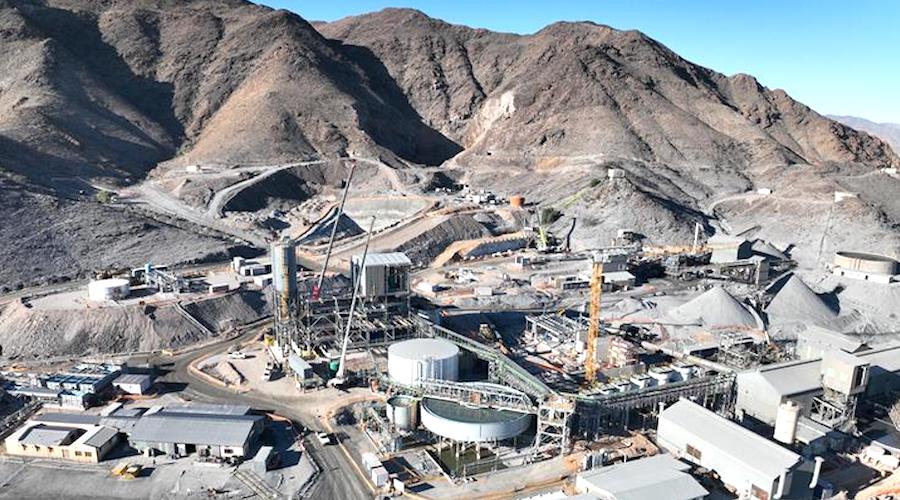
Rosh Pinah zinc mine in southern Namibia. (Image courtesy of Appian Capital Advisory.)
Appian Capital Advisory has secured a $150 million debt facility from Standard Bank to complete the expansion of its majority-owned Rosh Pinah zinc mine (RPZ) in southern Namibia.
The financing will cover the remaining construction costs of the Rosh Pinah 2.0 project (RP2.0), which is more than 80% complete and on track for full commissioning in the third quarter of 2026. The expansion aims to nearly double throughput to 1.3 million tonnes a year, equal to about 170 million pounds of zinc.
The project includes developing additional underground deposits and building new surface facilities, including a processing plant, paste fill and water treatment plant, and a new portal and decline.
“Securing this financing is a major step forward for RPZ and RP2.0,” Ignacio Bustamante, Appian’s head of base metals, said in a statement. “The expansion is a key component of our strategy to optimise operations and extend mine life.”
Alex Mayrick, the mine’s general manager, said Standard Bank’s involvement reflected confidence in the long-term prospects of the operation.
Solar-powered
About 30% of the mine’s energy needs are being met by the Rosh Pinah Solar Park, in which Appian took a controlling stake earlier this year. The plant supplies electricity at a fixed rate under a 15-year offtake agreement with Emesco Energy, cutting energy costs by 8%.
Appian plans to boost the solar plant’s capacity from 5.4MWp (megawatt peak) to 16.3MWp, with Emesco continuing as operator.
https://www.mining.com/appian-secures-150m-for-namibia-zinc-mine-expansion/

Australian Critical Minerals (ASX:ACM) has gained shareholder approval to acquire Circuit Resources, a privately held business with precious and base metal projects in Peru.
In June 2025, the company entered into a binding share purchase agreement to acquire Circuit’s six projects considered prospective gold and copper, as well as silver, lead, and zinc.
As Mining.com.au reported, Australian Critical Minerals will issue 45 million shares to Circuit shareholders, as well 5 million quoted options exercisable at $0.30 on or before 28 June 2026.
The company has indicated it will conduct NSAMT geophysics to refine silicification at depth and obtain an initial drill permit at the Flint Project in the next three months.
Additionally, Australian Critical will continue advancing geological mapping and sampling at the group’s Riqueza and Cerro Rayas projects with drilling expected to take place in Q2 2026.
Managing Director Dean de Largie says Peru is among the world’s premier mining regions – rich in copper, silver, zinc, and gold.
“What makes this so exciting is how ready we are to move,” de Largie says.
“Several are already drill-ready, with Flint first in line. Permitting is well advanced there and the geology points to significant high-sulphidation gold potential. Flint is only the beginning.
“Projects like Riqueza and Cerro Rayas follow close behind, giving us a strong pipeline for continuous exploration and newsflow. Our goal is straightforward: advance these projects methodically and create lasting value.”

Peru is ranked second in the world for zinc production, totalling 1.3 million tonnes per year, as well as third in the world for copper and silver, totalling 2.7 million tonnes and 3,000 tonnes per year, respectively.
Further, Peru is also ranked fourth in the world for lead production totalling 250,000 tonnes per year.
Australian Critical Minerals says it is uniquely positioned to capital on strong global demand for gold, copper, base metals, and lithium.
Images: Australian Critical Minerals
https://mining.com.au/australian-critical-unlocks-peruvian-opportunity/
Miners will be permitted to export up to 18,125t of cobalt for the remainder of 2025, followed by annual quotas of 96,600t for both 2026 and 2027.
The DRC accounted for around 70% of global cobalt production last year. Credit: RHJPhtotos/Shutterstock.com.
The Democratic Republic of Congo (DRC) is planning to replace its cobalt export ban with an annual quota system, effective from 16 October 2025.
The DRC’s mining regulator will permit miners to export up to 18,125 tonnes (t) of cobalt for the remainder of 2025, followed by annual quotas of 96,600t for both 2026 and 2027.
The DRC, which accounted for around 70% of global cobalt production last year, imposed the export ban in February 2023 after cobalt prices fell to a nine-year low, reported Reuters.
The ban was extended in June this year, leading to force majeure declarations from key producers such as Swiss miner Glencore and China-based CMOC Group.
According to the report, the large-scale unregulated artisanal mining sector in the DRC plays a significant role in the production of cobalt, a critical material for electric batteries.
Unregulated mining poses challenges for traceability and compliance for international buyers.
The shift to a quota is said to address the rising conflict in eastern Congo, where the government asserts that illegal mining contributes to violence involving M23 rebels.
The new quota system aims to manage inventories and stabilise prices.
This system has received support from Glencore but faces opposition from CMOC, reported Reuters, citing sources.
In May 2025, CMOC was reported to have requested that the DRC lift a ban on exports of the battery metal, which was due to expire the following month.
Traders from Glencore stated that a stable price is needed before the export ban is lifted, and cobalt-producing countries like the DRC and Indonesia need to manage oversupply.
According to the DRC’s Authority for the Regulation and Control of Strategic Mineral Substances’ Markets, quotas will be determined based on historical exports of cobalt.
The regulator announced that 10% of the future export volumes will be used for national strategic projects, and the quotas may be adjusted depending on market conditions or advancements in local refining capabilities.
Additionally, the regulator has the authority to repurchase cobalt stocks that exceed the quarterly quotas assigned to individual companies, said the news agency.
Glencore is said to be in discussions to sell a majority stake in the Kamoto Copper Company (KCC) in the DRC, according to Bloomberg.
KCC, which operates a major copper and cobalt project in the DRC, has faced operational challenges and a royalty-related dispute with the Congolese Government, amid a slump in cobalt prices.
https://www.mining-technology.com/news/congo-to-lift-cobalt-export-ban-and-launch-quotas/?cf-view
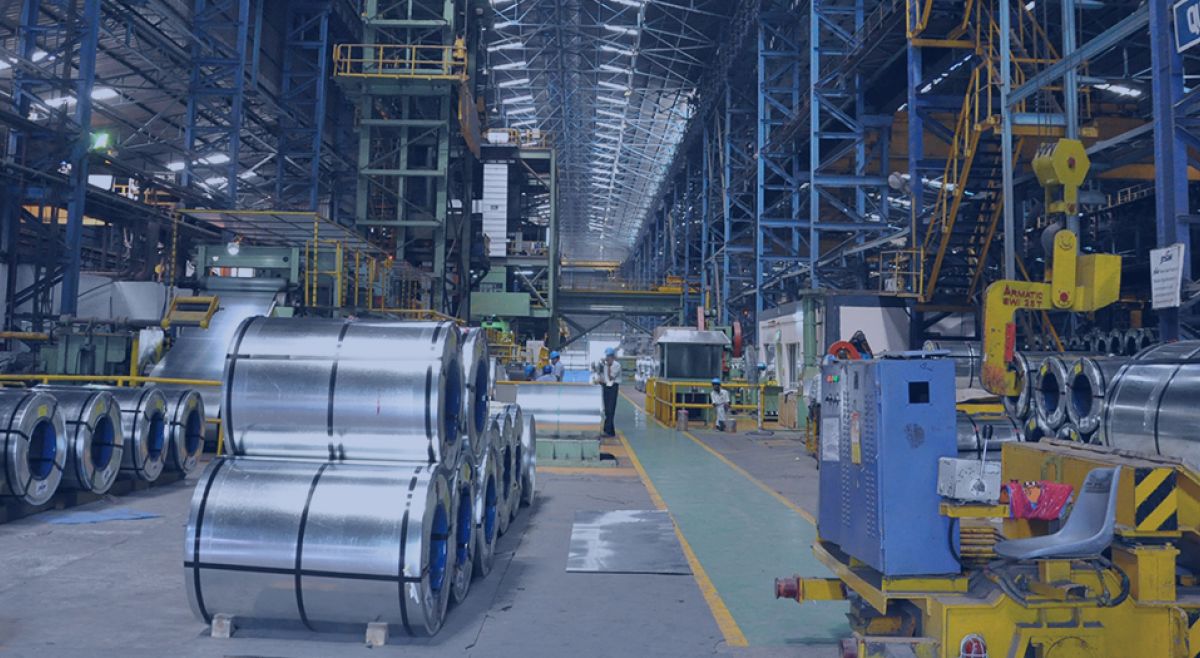
DGTR recommends protecting Indian manufacturers from cheap imports of cold-rolled electrical steel from China
The Directorate General of Trade Remedies (DGTR) under the Indian Ministry of Commerce has recommended the imposition of anti-dumping duties for a period of five years on imports of cold-rolled non-oriented electrical steel from China. The measure aims to protect domestic producers from cheap imports that threaten their business. This was reported by ET.
In its final conclusion, the DGTR noted that the products were exported to India at a price below normal value, which led to dumping on the market. As a result, the agency recommends imposing a duty of $223.82/t on certain Chinese companies and $414.92/t on others.
“The authority recommends the imposition of anti-dumping duties for five years,” the DGTR said in an official statement.
The final decision on the imposition of duties will be made by the Indian Ministry of Finance.
According to the DGTR, the imposition of duties should ensure fair trade conditions and equal competition between local producers and foreign suppliers. India already applies anti-dumping measures to a number of goods to counter cheap imports from various countries, including China.
It is noted that India has a trade deficit with China of about $100 billion, which makes control over dumped imports particularly relevant for protecting domestic producers and stabilizing the market.
As GMK Center reported earlier, India reached its target steel production capacity of 205 million tons per year in the 2024/2025 financial year. The country is confidently moving towards its strategic goal of 300 million tons per year by the 2030/2031 financial year.
https://gmk.center/en/news/india-plans-five-year-anti-dumping-duty-on-chinese-electrical-steel/
Last week, the European Economic and Social Committee (EESC) presented its opinion on the EU Action Plan for Steel and Metals.
It notes that over the last decade, the EU’s share of global steel production has fallen to 7-8%. The European steel industry is in crisis, and urgent action is needed to restore the sector’s competitiveness, protect jobs, and encourage investment during the transition period.
The Committee advocates new comprehensive trade measures for steel to replace those currently in force until their expiry (July 1, 2026). They should cover all countries and relevant steel products using tariff quotas linked to market share and capacity utilization.
The EESC calls for the immediate introduction of a “smelting and casting” rule to prevent circumvention and improve the tracking of steel imports, and for the suspension of the “lesser duty” rule where necessary.
The opinion calls for the publication of a draft law on a carbon border adjustment mechanism (CBAM), which would, in particular, provide for free permits for exports to third countries that do not have comparable climate policies.
In addition, the committee calls on the EC to recognize the importance of scrap as a secondary raw material, among other things by proposing systems to monitor its export.
It is also necessary to develop specific guidelines to support temporary energy price reduction schemes for energy-intensive industries affected by international trade and structural reform of the electricity market.
The committee recommends assessing the investment needs of the steel industry and increasing targeted financial support, potentially using revenues from CBAM and EU ETS for industrial decarbonization projects.
It is proposed to create a Just Transition Fund focused on energy-intensive industries, concentrating on upskilling, reskilling, and supporting worker mobility.
The European Steel Association (EUROFER) welcomed the commitment by European Commissioner for Trade Maroš Šefčovič to present protective measures for steel by mid-October to replace the existing ones.
SMM September 23, SS futures were in the doldrums. Although the night session remained relatively strong, the daytime session weakened gradually after a brief fluctuation at the opening, eventually closing down at 12,890 yuan/mt. Spot market, dragged by the pullback in SS futures, saw weakened market confidence, with spot inquiries significantly lower than yesterday. Despite traders slightly lowering prices to sell, actual trading volume remained sluggish. Additionally, affected by Typhoon "Hagibis", shipments and cargo pick-up in Foshan were disrupted, and some traders chose to take the day off today.
Futures side, the most-traded contract 2511 traded in the doldrums. At 10:30 am, SS2511 was quoted at 12,885 yuan/mt, down 45 yuan/mt from the previous trading day. Wuxi spot premiums/discounts for 304/2B were in the range of 335-635 yuan/mt. In the spot market, Wuxi cold-rolled 201/2B coil averaged 8,050 yuan/mt; cold-rolled mill-edge 304/2B coil averaged 13,200 yuan/mt in both Wuxi and Foshan; cold-rolled 316L/2B coil was 25,650 yuan/mt in both Wuxi and Foshan; hot-rolled 316L/NO.1 coil was quoted at 24,950 yuan/mt in both locations; cold-rolled 430/2B coil was 7,600 yuan/mt in both Wuxi and Foshan.
Despite the traditional September-October peak season, end-use demand for stainless steel did recover compared to earlier periods, but as stainless steel mill production increased simultaneously during the month, the stainless steel market did not show a significant strengthening trend. Market participants generally felt the overall atmosphere was sluggish, and the market did not exhibit the vibrant trading scene expected during the peak season. Although inventory gradually declined, stainless steel spot prices struggled to rise. This week, the US Fed cut interest rates by 25 basis points, in line with previous market expectations. SS futures had already struggled to break through the previous bottleneck of 13,000 yuan/mt, and after the short-term macro tailwinds were realized, the futures turned downward. Downstream acceptance of high prices in the spot market was already low, and the pullback in futures prices further intensified wait-and-see sentiment. Additionally, cost side, further increases in nickel and chromium raw material prices encountered resistance. Although, in the short term, influenced by the traditional peak season, low social inventory, and pre-holiday stockpiling demand ahead of the National Day holiday, stainless steel prices are unlikely to see significant declines, the momentum for further increases has clearly weakened.
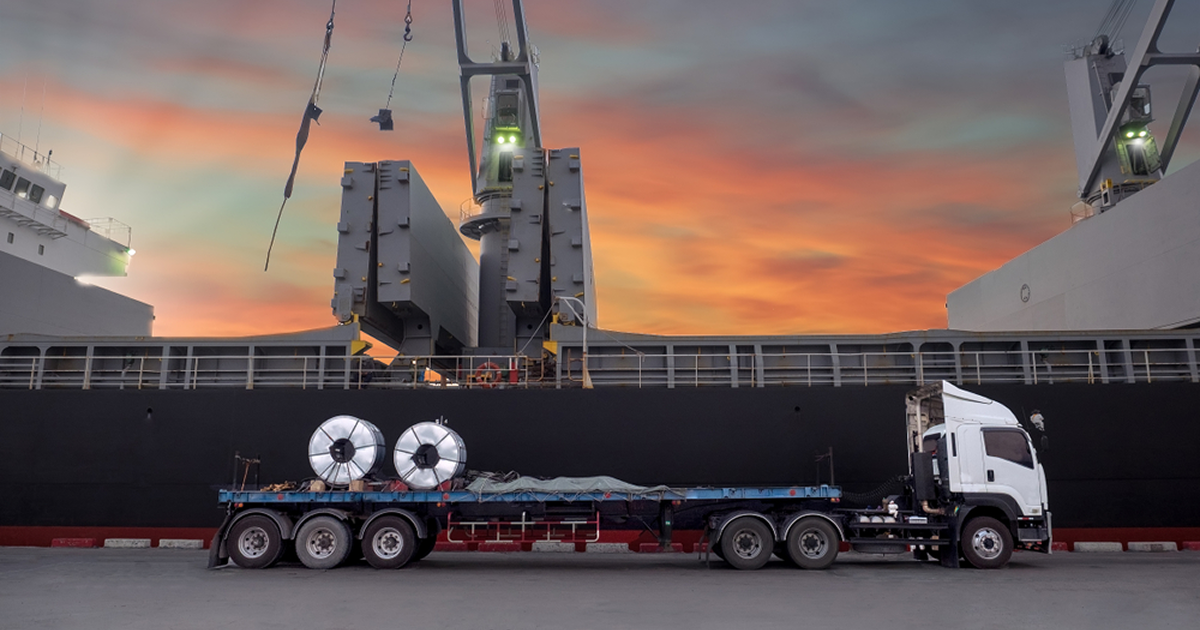
The government promises to continue negotiations with Washington on reducing tariffs
The South Korean government will introduce a new export guarantee program for the steel industry amid US tariffs. This was announced by the country’s Minister of Industry Kim Jong-kwan, according to The Korea Times.
The official made the announcement late last week during a meeting in Pohang with the heads of the country’s major steel companies, including POSCO.
“The government, steel producers, financial institutions, and lenders will work together to create a guaranteed scheme to strengthen the steel industry’s supply chains,” Kim said.
The minister explained that the measure is intended to provide financial support of approximately 400 billion won ($290 million).
Kim promised to continue negotiations with the US on reducing tariffs, introduce further measures to support the industry, and intensify efforts to protect against unfair imports. The government also seeks to ease economic tensions in regions caused by difficulties in the steel industry.
In addition, South Korea’s Ministry of Trade, Industry, and Energy held a meeting with private companies and trade agencies to discuss the country’s response to the potential expansion of US tariffs on steel and aluminum derivatives. In August, the Trump administration already imposed 50% tariffs on 407 new commodity codes.
The ministry held the meeting to assess the potential impact of Washington’s move and discuss measures to support Korean industry. In particular, the ministry promised to help companies submit written comments to the Trump administration against the expansion of tariffs and to provide advice on the export of affected goods.
It should be recalled that this summer, a bipartisan bill was introduced in the country to help local steel producers affected by the 50% US tariff and the sharp increase in imports of cheap Chinese products. The K-Steel Act, announced by 106 lawmakers, outlines a long-term industrial strategy that views steel as the foundation of national security and economic stability.
The bulk of imports consisted of cast iron, semi-finished steel products, and direct reduced iron
The European Union (EU) imported 3.37 million tons (+0.6% y/y) of Russian-origin steel raw materials in January-July 2025. The cost of importing these products reached €1.39 billion (-14.4% y/y). This is evidenced by GMK Center calculations based on Eurostat data.
The bulk of imports consists of semi-finished products. In the first seven months of 2025, 2.18 million tons of semi-finished products (+13.2% y/y) were shipped to the EU. The cost of these imports amounted to €982.38 million (-1.5% y/y). The largest consumers of semi-finished products from Russia are Belgium – 826.7 thousand tons (+9% y/y), Italy – 510.93 thousand tons (+22.7% y/y), the Czech Republic – 454.38 thousand tons (+63.1% y/y), and Denmark – 334.71 thousand tons (+12.9% y/y).
Large volumes of imports also fell on cast iron – 696.99 thousand tons (+3.3% y/y). The revenue of Russian iron and steel companies from supplying the relevant products to the EU market amounted to €254.45 million (-7.6% y/y). The main volumes were sent to Italy – 524.62 thousand tons (+4.6% y/y), Latvia – 87.27 thousand tons (+2.1% y/y), and Belgium – 31.07 thousand tons (+96.6% y/y).

There were almost no deliveries of Russian-made ferroalloys to the EU market in January-August 2025 – 3.8 tons compared to 48.52 thousand tons a year earlier.
Scrap imports from Russia amounted to 43.59 thousand tons (+2.2 times y-o-y), and procurement costs amounted to €14.54 million (+23.9% y-o-y). Iron ore supplies amounted to 2.04 thousand tons (9.36 thousand tons in January-July 2024). At the same time, imports of direct reduced iron (DRI) during this period amounted to 441.68 thousand tons (-33.7% y/y) for €138.29 million (-39.2% y/y).
In July 2025, the EU imported 414.89 thousand tons (-12.3% y/y; +8.4% m/m) of iron and steel products from Russia, including:
Revenue of Russian steelmakers from exports to the EU in July amounted to €168.72 million, which is 25.2% less y/y and 3.3% more m/m.
As a reminder, the EU imported 5.34 million tons of iron and steel products from Russia in 2024. Despite sanctions, Russian producers continue to receive significant revenues from exports to the EU, with last year’s total exceeding €2.5 billion. This indicates the weak effectiveness of the current restrictions and the existence of exemptions that allow Russian steel companies to export to EU markets.