Barrick CA06849F1080
Canada's mining powerhouse Barrick Gold is evaluating a transformative corporate division that would separate its operations into two distinct entities. Board members are actively debating a potential split that would create one company focused on North American assets and another managing African and Asian holdings. This strategic shift comes as investors enjoy substantial share price appreciation, raising questions about the timing and implications of such a structural overhaul.

The restructuring discussions follow an exceptional third-quarter 2025 performance where Barrick delivered multiple record-breaking financial results:
This financial strength stemmed from a 4 percent expansion in gold production combined with favorable gold price movements. Market response has been overwhelmingly positive, with shares advancing 12 percent in the latest trading week and doubling in value over the preceding six-month period.
Strategic Shift Toward Political Stability
Interim CEO Mark Hill has clarified the strategic direction behind the potential reorganization. Barrick intends to concentrate its future operations on politically stable regions, specifically targeting mines in Nevada and the Dominican Republic for primary development. This reorientation would involve spinning off or divesting African assets along with the Reko Diq mine in Pakistan.
The market immediately responded to this strategic clarity, with Barrick's Toronto-listed equity gaining 3 percent following the announcements. The company's North American operations are considered crown jewels within its portfolio, while African and Pakistani projects carry elevated geopolitical risk profiles that complicate operations.
Shareholder Returns Accelerate
Barrick is channeling its substantial cash generation toward enhanced shareholder returns through multiple avenues. The company has raised its quarterly base dividend by 25 percent to $0.175 per share while simultaneously executing an aggressive share repurchase initiative. The buyback program has already deployed $1.0 billion this year alone.
This robust capital return strategy is attracting significant institutional interest. Bank of New York Mellon Corp established a new position exceeding 1.6 million shares valued at approximately $33.8 million. Additional investment firms have initiated positions while equity researchers across the sector have been upgrading their price targets for Barrick stock.
Dutch court maintains freeze on Gazprom pipeline assets
Tom Jones 17 November 2025
The frozen assets are in Dutch bank ABN Amro (Credit: shutterstock.com/Dutchmen Photography)
A Dutch court has upheld the provisional attachment of assets of a gas pipeline operator owned by Russia’s Gazprom, which were frozen by a Ukrainian energy company seeking to enforce a US$300 million investment treaty award.
https://globalarbitrationreview.com/article/dutch-court-maintains-freeze-gazprom-pipeline-assets
Japan’s 10-year government bond yield climbed above 1.77% on Wednesday, marking a fresh 17-year high ahead of a crucial debt auction that could indicate investor demand amid rising fiscal concerns.
The Ministry of Finance plans to auction around 800 billion yen in 20-year JGBs.
On Tuesday, the government proposed a supplementary budget exceeding 25 trillion yen to fund Prime Minister Sanae Takaichi’s stimulus plan, far above last year’s 13.9 trillion yen extra budget, stoking debt worries.
Meanwhile, Bank of Japan Governor Kazuo Ueda told the prime minister that the central bank is gradually raising rates to steer inflation toward its 2% target while supporting sustainable growth.
Afterward, Ueda told reporters the prime minister made no specific request on monetary policy.
On the data front, machinery orders in Japan rose more than expected in September, signaling robust capital spending.
Ukraine War, Day 1,365: Trump-Kremlin Plan for Capitulation of Kyiv
Posted by Scott Lucas | Nov 20, 2025 |

Donald Trump and Vladimir Putin at a conference in 2017 (EPA)
UPDATE 0812 GMT:
Ukrainian drones have attacked the Ryazan oil refinery in western Russia for the second time in a week, the third time this autumn, and the fifth time since August 2.
Russian and Ukrainian monitoring channels reported the attack. Ryazan Governor Pavel Malkov acknowledged, “Falling debris caused a fire at a plant. According to preliminary information, there are no casualties, and material damage is being assessed.”
The refinery is one of the largest in Russia, supplied fuel to the Moscow region. Owned by Rosneft, it processed 13.1 million tons of crude oil in 2024, accounting for 5% of Russia’s total refining capacity.
After an attack last Saturday, the refinery suspended operation because of the loss of its main refining unit.
In the Kursk region in western Russia on Ukraine’s border, more than 16,000 people are without power after a strike on an electrical substation.
ORIGINAL ENTRY: The Trump Administration and the Kremlin have drafted a 28-point plan for Ukraine’s capitulation to Russia’s 46-month full-scale invasion.
The plan has been crafted amid discussions between Donald Trump’s envoy, real estate developer Steve Witkoff, and Vladimir Putin’s senior economic advisor Kiril Dmitriev.
“People with knowledge” said Ukraine would give up the 22% of the Donetsk region which it holds — a Kremlin demand favored by Witkoff but rejected by Trump last month.
The surrender will occur despite warnings to Trump by Ukraine’s European partners that the handover of the fortified area would “open the highway to Kyiv” in any future Russian offensive.
Further aiding any Russian assault, Ukraine will cut the size of its armed forces by half and abandon key categories of weaponry. US military assistance will be rolled back, and Ukraine will not get any long-range weapons. No foreign troops will be allowed on Ukrainian soil.
The sources did not mention any security guarantee to Ukraine against Russian aggression.
The plan also demands the recognition of Russian as an official state language in Ukraine. The local branch of the Russian Orthodox Church will be given formal status.
A source summarized that the proposal amounted to Ukraine giving up its sovereignty. The initiative was a Russian attempt to “play” the Trump Administration, eager to “show progress” on a deal.
One official noted that the plan iss “heavily tilted towards Russia”. Another called it “very comfortable for Putin”.
A “Russian person familiar with the matter” said, “It’s not a plan but a mix of real, practical proposals with good intentions. They acknowledged, “Part of it is absolutely unacceptable for the Ukrainians.”
An Ultimatum to Ukraine?
Witkoff presented the plan this week to Ukraine’s Secretary of the National Security and Defense Council, Rustem Umerov, in Miami. The envoy made clear he wanted President Volodymyr Zelensky to accept the terms.
Officials in Kyiv said the plan, closely aligned with the Kremlin’s maximalist demands, is a non-starter without significant changes.
The real estate developer was scheduled to meet Zelensky in Turkey on Wednesday. However, without explanation, he pulled out of the encounter.
The Trump Administration is sending Army Secretary Dan Driscoll and two four-star generals to Kyiv to meet Zelensky and other Ukrainian officials.
Senior US officials said the Pentagon delegation will meet with Russian officials at a later date. They did not explain why Trump’s envoy to Ukraine, Keith Kellogg, is not included.
US Secretary of State Marco Rubio posted on social media:

Russia Murders 26+ Civilians, Injures 115+ Across Ukraine
The existence of the plan was revealed as Russia murdered at least 26 civilians, including three children, and injured 73 in Ternopil in western Ukraine. Missile and drone attacks wounded another 42 elsewhere in the country.
Meeting Turkish President Recep Tayyip Erdoğan in Ankara, Zelensky posted:
"Since the beginning of this year, we in Ukraine have supported every decisive step and the leadership of [#Trump], every strong and fair proposal aimed at ending this war. And only President Trump and the United States have sufficient power to make this war come to an end."
Zelensky noted Erdoğan’s proposal of formats for negotiations, and emphasized that this “is important for us”.
"But the most important factor for stopping the bloodshed and achieving lasting peace is that we work in close coordination with all partners, and that American leadership remains effective, strong, and brings us closer to a peace that endures and ensures security for the people."
https://eaworldview.com/2025/11/ukraine-war-trump-kremlin-plan-for-capitulation-of-kyiv/
This paper extends the New Industrial Policy Observatory (NIPO) dataset from 2009 to 2023 by employing large language model techniques to identify policy motivations. We document widespread industrial policy adoption across advanced and emerging market economies since the Great Financial Crisis, which was implemented primarily through subsidies and trade restrictions. We identify a structural break around 2020, characterized by accelerated policy activity and the emergence of “new industrial policies” motivated by supply chain resilience, national security, and geopolitical concerns, in addition to policies focused on competitiveness and climate objectives, which were already prevalent in previous years. Policies have targeted dual-use and various advanced technology sectors, as well as their upstream inputs, such as critical raw materials and minerals. We find that geopolitical risk and tit-for-tat retaliation have played a greater role in driving industrial policy after 2020, and that this support extends beyond existing sectors of comparative advantage.
https://globaltradealert.org/reports/Industrial-Policy-Since-the-Great-Financial-Crisis

Donald Tusk (brown jacket, hands in pocket) visits the site of the damage in a photo he posted on XPhotograph: Twitter/X
Here is a summary of what we know so far:

Event
In the end of October, contrarily to polling predictions, Javier Milei achieved a landslide victory in the midterm elections, with his party La Libertad Avanza (LLA) winning 41% of the vote over 32% for the opposition alliance. This result marks a strong public endorsement of his macroeconomic reform agenda.
Impact
This clear election victory comes as a relief to panicking financial markets. In the run-up to the midterms, the Argentine peso experienced multiple runs, weekly breaching the upper limit of its managed exchange rate band (see graph 1), triggering a quick decrease in foreign exchange reserves. In September, Milei’s poor performance at the local elections in Buenos Aires had casted doubt about his political momentum amid multiple domestic shocks. To contain market panic, the US took the unusual step to directly purchase Argentine pesos (for around USD 2 billion) and offered an extraordinary bailout programme with a USD 20 billion swap line upon the condition that President Milei secures a (large) electoral win.

Today, President Milei’s strong electoral win appears to have secured the USD 20 billion US swap line, although the specific conditions linked to it remain undisclosed. Moreover, LLA now holds sufficient legislative power to advance fiscal reforms without the opposition being able to overturn key legislation (which it did in the run-up to the midterm elections), safeguarding Argentina’s fiscal surplus and vital IMF programme. However, to implement deeper structural reforms with a long-term impact, Milei will need to build alliances with other political parties, an area where he has historically struggled.
In the short term, pressures on the Argentine currency should ease and foreign exchange reserves remain at an acceptable level (see graph 2). Nonetheless, risks remain elevated. First, Argentina’s government will need to quickly accumulate foreign currency reserves, given more than USD 25 billion of external debt service is due in 2026. Second, the currently managed currency band is overvalued and impedes foreign exchange reserves build-up, yet the Argentine authorities are committed to maintaining it. Furthermore, continuous US backing may hinge on Argentina distancing itself from China – Argentine’s main trade partner and provider of a USD 13 billion swap line, included in the foreign exchange reserves data – amid intensifying geopolitical rivalry, Milei’s political stability (while unrest is likely to increase) and reform credibility. Finally, another run on the peso and a quick decrease in foreign exchange reserves cannot be ruled out in the medium term given the overvalued exchange rate, and particularly in the run-up to the presidential elections of 2027. Argentina’s history of balance of payment crises and the implementation of foreign exchange controls underscore these vulnerabilities.

In this context, the outlook for the short-term political risk (6/7) – which represents the country’s liquidity – and for the medium- to long-term political risk (7/7) is stable.
New indexes provide independent transparency to support offtake agreements
LONDON, Nov. 19, 2025 /PRNewswire/ -- Global energy and commodity price reporting agency Argus has launched the world's first calculated prices for e-SAF (electrolytic sustainable aviation fuel). The modelled production costs will support offtake agreement negotiations and provide new transparency to help the energy industry address environmental requirements.
Governments recognise that biofuel-based SAF alone cannot decarbonise aviation, because renewable feedstocks, mostly used cooking oil, are a finite resource. As a result, the industry will need to use e-SAF, which is produced directly from hydrogen and carbon dioxide molecules.
Mandates for use of e-SAF in aviation take effect from 2028 in the UK and from 2030 in the EU, with significant penalties for non-compliance. Yet the industry is nowhere near ready. Of the 70 proposed e-SAF plants in the UK and EU tracked by Argus, no commercial-scale plant has yet reached a final investment decision (FID). Plants take three to four years to build, so FIDs must be taken within the next year if targets are to be met.
E-SAF as a pioneering technology is more expensive than bio-SAF and conventional jet fuel. The new Argus calculated costs for e-SAF production in November 2025 show it is currently 13 times the cost of conventional jet fuel and 3.5 times the cost of bio-SAF (produced using the HEFA SPK pathway) in northwest Europe.
Argus Media chairman and chief executive Adrian Binks said: "Long-term e-SAF offtake agreements are essential to the financing of production facilities. But buyers are wary of committing tens of millions of dollars in such agreements, and this has created a disconnect between supply obligations and demand, which in turn has stalled investment. Our new modelled costs will provide important independent transparency upon which participants across the e-SAF value chain can rely to inform their long-term decision making."
The new weekly indexes compute the production cost of e-SAF in the Amsterdam-Rotterdam-Antwerp (ARA) region of northwest Europe on a €/t and $/t basis, and are published both inclusive and exclusive of capital expenditure.
These new calculated prices expand Argus' SAF offering, building on well-established market references in northwest Europe, Asia-Pacific and the US for hydrotreated esters and fatty acids synthesised paraffinic kerosene (HEFA-SPK) bio-SAF. The calculation methodology draws on Argus' pricing and consultancy expertise across biofuels, natural gas and hydrogen.

The U.S. stock market is rising on Wednesday, for now at least, ahead of a huge couple of tests for Wall Street.
The S&P 500 added 0.4 per cent after trimming an earlier jump of 1.1 per cent.
It's coming off a four-day losing streak, its longest in nearly three months, and has been shaking recently because of worries that stock prices have shot too high and that the U.S. Federal Reserve may not deliver as many revitalizing cuts to interest rates as expected.
The Dow Jones Industrial Average was down 98 points, or 0.2 per cent, as of 11 a.m. ET, after an earlier gain evaporated. The Nasdaq composite rose 0.8 per cent.

Constellation Energy helped lead the market and rallied 6.1 per cent after the U.S. Department of Energy said it's lending $1 billion US to help restart Constellation's nuclear power plant at Three Mile Island.
Lowe's rose 4.8 per cent after the home-improvement retailer reported a stronger profit for the summer than analysts expected.
They helped offset a 1.5 per cent drop for Target, which reported a stronger profit, but also weaker revenue, for the latest quarter than analysts expected. The retailer hinted that challenges may continue through the critical holiday shopping season.

Nvidia president and CEO Jensen Huang delivers a keynote address during a technology conference at the Walter E. Washington Convention Center in Washington, D.C., on Oct. 28. (Anna Moneymaker/Getty Images)
The market's focus, though, remained squarely on Nvidia.
Nvidia reports its earnings for the last quarter after the closing bell. The California company climbed 2.6 per cent to recover some of its loss for the month so far, which topped 10 per cent on Tuesday.
The company, which at one point briefly topped $5 trillion US in value, has become the largest stock on Wall Street. That means its movements carry more weight on the S&P 500 than any other stock, and it can single-handedly steer the index's direction some days.
One way Nvidia can quiet criticism that its stock shot too high, which led to this month's struggles, is to keep delivering bigger profits, because stock prices tend to track profits over the long term.
Nvidia has also become a bellwether for the broader frenzy around artificial intelligence technology, because other companies are using its chips to ramp up their AI efforts.
Those AI-linked stocks, along with Nvidia, have been a major reason the U.S. stock market has been setting records, with the latest for the S&P 500 coming late last month.
Worries have been rising, though, that all the investment may not produce as much profit and productivity for the overall economy, as earlier hoped.
Critics have been suggesting AI's surge is similar to the bubble that enveloped dot-com stocks, which ultimately imploded in 2000 and dragged the S&P 500 down by nearly half.
https://www.cbc.ca/news/business/stock-markets-nvidia-earnings-9.6984305

At a Glance
When Disruption Hit, AI Made the Difference
2025 tested the maritime domain and redefined the standards for visibility, speed, and resilience.
Traditional systems failed to keep pace. From sudden sanctions and rerouting chaos to flag-switching and dark flows, each new disruption exposed the limitations of static watchlists, manual screenings, and delayed alerts.
But for the organizations powered by Maritime AI™, the story was different.
These teams weren’t relying on a single data source. They were fusing vessel behavior, AIS tracking, and real-time alerts with satellite-powered detections to get the full picture, even when ships went dark or falsified their identities.
Remote sensing played a central role. By layering SAR, EO, and RF detections with AI-based anomaly detection, organizations were able to confirm vessel positions, flag deceptive movements, and track suspicious activity, even when traditional signals were spoofed or offline.
In practice, this meant spotting deceptive shipping practices (DSPs) as they happened, validating threats before exposure, and maintaining momentum even amid sanctions, spoofing, and shifting trade patterns.
The more complex the threat landscape became, the clearer the gap was: static systems created noise. Maritime AI™ delivered clarity.
Quarter by Quarter: A Test of Resilience
Q1: A Disrupted Start
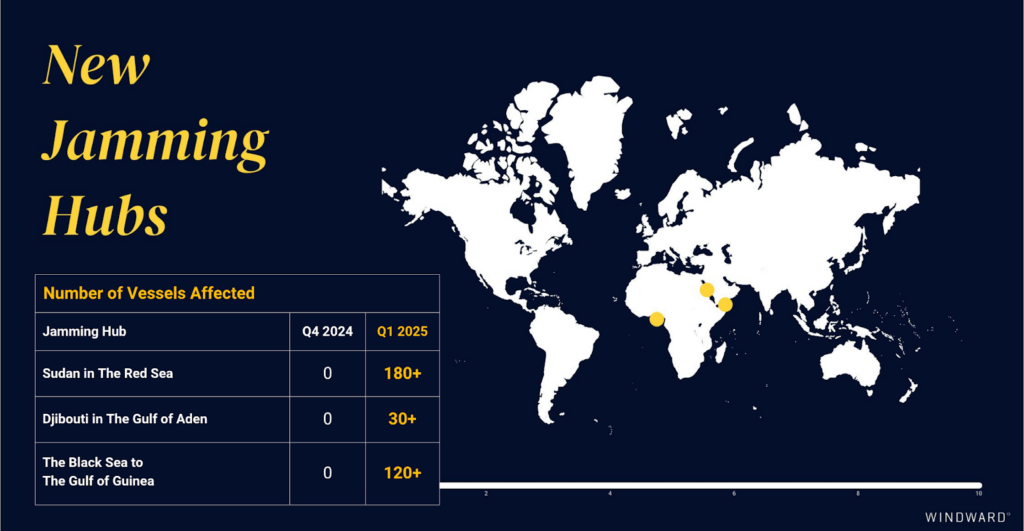
2025 opened with a surge in location deception that disrupted even the most basic maritime function: knowing where a vessel actually was. Over 330 ships were affected by GPS spoofing and jamming, with new hotspots emerging across the Red Sea, the Gulf of Aden, and West Africa. These disruptions made it harder to track ships, validate port calls, and confirm counterparty activity. Vessels that had sailed without issue in Q4 2024 suddenly vanished from tracking systems, including more than 180 ships near Sudan, over 30 near Djibouti, and more than 120 between the Black Sea and the Gulf of Guinea.
March marked a sharp pivot in U.S. trade lanes. Tanker flows to Mexico and Canada dropped steeply, likely tied to new energy tariffs, while U.S.-China routes showed a post-front-loading slowdown in both container and bulk traffic. These shifts signaled how policy volatility was already reshaping behavior in real time.
For many, the result was a deeper operational blind spot. Without real-time visibility, teams struggled to assess exposure, validate movements, or respond before disruptions escalated.
Q2: A New Layer of Complexity
The second quarter brought new challenges and exposed deeper operational pressure points. The Red Sea conflict escalated, forcing widespread rerouting across the region. Major container flows were diverted to alternative routes, leading to congestion at secondary hubs like Singapore and Busan. Anchorage delays climbed, supply chains buckled, and logistics teams faced mounting uncertainty in planning and forecasting.
Deceptive practices surged. GPS jamming affected over 13,000 vessels, with new hotspots in the Arabian Gulf, Mediterranean, and Baltic Sea. During the Iran conflict, jamming triggered a wave of false port calls near critical terminals like Asaluyeh and Bandar Abbas. At the same time, false flag registrations spiked, with new fraudulent registries, including Eswatini and Guyana, attracting dark and gray fleet vessels seeking to obscure their identity and intent.
GPS Jamming in the Arabian Gulf (Q2 2025)
The integrity of documents and data could no longer be assumed. As misleading records and tampered signals proliferated, compliance and operations teams struggled to distinguish between technical errors and high-risk deception.
For systems built on static watchlists and manual checks, the gap widened. Without automation and real-time intelligence, the ability to detect, validate, and respond was lost in the noise.
Q3: The Risk Multiplier
The third quarter compounded existing stressors with escalating policy shocks. U.S.-China tariffs and retaliatory port fees upended shipping patterns, forcing container lines to rework schedules and reroute sailings. Counter-seasonal flows, blank sailings, and shifting demand drove delays and freight rate volatility across major Asia-Europe corridors. At key hubs like Rotterdam and Singapore, missed connections, rollovers, and transshipment disruptions surged.
Sanctions reached new extremes. Over 1,000 vessels had been blacklisted by Q3, including container ships and tankers tied to Russia, Iran, and other sanctioned regimes. False flag use doubled since January as operators scrambled to avoid deregistration. Dark and gray fleet operations expanded, with Comoros, Panama, and Russia dominating dark fleet registries, and deceptive shipping practices spreading across key global hubs.
The signal-to-noise problem deepened. Over 11,600 vessels were impacted by GPS jamming in Q3, a 510% spike from Q1, with a new jamming hub near Nakhodka Bay disrupting tracking around Russia’s Pacific export terminals. Combined with drifting, spoofing, and flag hopping, the cumulative effect clouded due diligence and operational visibility.

Jamming patterns in the Nakhodka Bay (left) during Q3 2025 and recent electronic interference off Qatar. Source: Windward Maritime AI™ Platform
By late Q3, many organizations were no longer navigating a single maritime environment, but a fragmented patchwork of enforcement rules, visibility gaps, and geopolitical fault lines.
Q4: A Fragile Finale
Just weeks into Q4, regulators escalated again, signaling that maritime trade remains a central front in sanctions enforcement.
In the EU’s 19th sanctions package, the focus shifted to core infrastructure:
These measures deepen the risk for any organization connected to Russian flows, even indirectly.
Meanwhile, the U.S. sanctioned Rosneft and Lukoil, Russia’s two largest oil firms, putting traders, charterers, and insurers on high alert. For the first time, enforcement is reaching upstream, threatening entire trade lifecycles, not just the ships that carry them.
The latest sanctions have changed the risk equation. With energy giants now in scope and enforcement expanding upstream, the pressure on maritime stakeholders is intensifying. Staying ahead means being able to validate counterparties, uncover hidden exposure, and respond with speed and certainty.
When Disruption Hit, AI Made the Difference
2025 was a real-world stress test for the maritime industry. Sanctions expanded, deceptive practices escalated, and global trade routes were upended, again and again. Through it all, organizations relying on manual processes struggled to keep pace. Those equipped with Maritime AI™ moved faster, validated threats, and adapted with precision.
In a year defined by deception, resilience came from clarity – intelligence you could trust, context you could act on, and systems built to adapt in real time.
With intelligent alerts, anomaly detection, and contextual risk scoring, AI-driven platforms helped users filter signal from noise, cutting through spoofing, false flags, and dark flows to see the true picture. Automated document validation added a critical layer of protection, helping stakeholders flag inconsistencies, identify tampering, and accelerate due diligence.
Remote sensing also played a growing role. As dark fleet behaviors evolved and GPS tracking became unreliable, fusing SAR, EO, RF, and AIS data enabled users to verify vessel location and behavior with visual confirmation and behavioral context. This fusion became essential for enforcement, insurance, trade, and logistics operations alike.
Static watchlists and outdated tools couldn’t keep up. But platforms powered by Maritime AI™ delivered dynamic, decision-ready intelligence, giving users the clarity and confidence to act.
2026 Is Coming With New Stress Tests
The challenges of 2025 aren’t behind us – they’re the blueprint for what’s next.
From the first signs of spoofing and trade rerouting to the latest wave of sanctions and registry abuse, this year has tested every part of maritime operations. It revealed which organizations could respond in real time, and which were left scrambling.
In Q4, the pressure continues to shift, with new enforcement angles, risk signals, and operational challenges emerging in real time.
2026 will demand more than awareness. It will require platforms that fuse behavioral intelligence, remote sensing intelligence, and document validation into a single, adaptive workflow, delivering the context and confidence to act before risk turns into exposure.
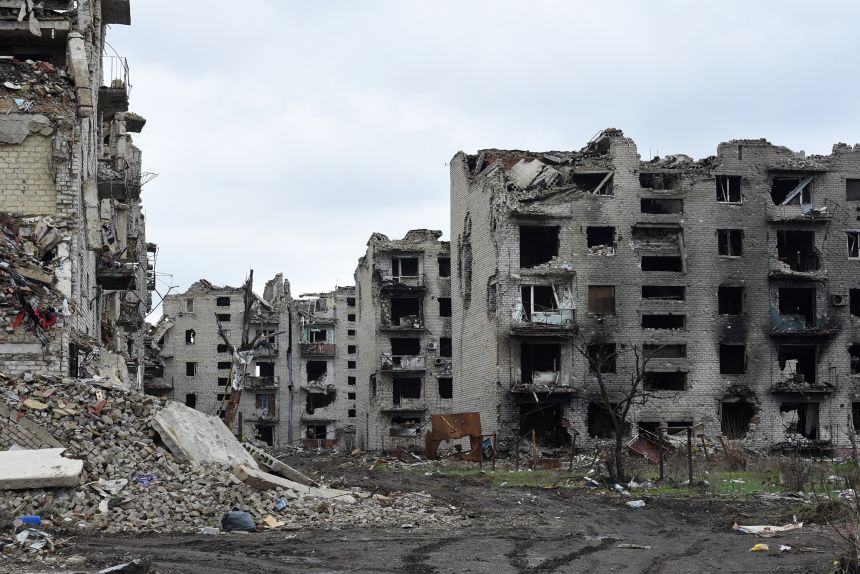
A view of a ruined and abandoned town in the Donetsk region, Russian-controlled Ukraine, on April 1, 2025, amid the ongoing Russian-Ukrainian conflict. AFP/Getty Images
A new Trump administration plan for the end of the war in Ukraine would see Kyiv cede territory to Russia, US “de facto” recognition of Crimea and other Ukrainian territory forcibly seized by the Kremlin as Russian, and limits to the size of Ukraine’s military, according to a draft of the plan obtained Thursday by CNN.
The draft’s veracity was confirmed to CNN by a US official. Many of the ideas put forward in the 28-point plan have been rejected in previous negotiations by Ukraine and European officials and would be seen as concessions to Russia.
US officials said the plan was still being worked on, and that any final agreement would require concessions from both sides, not just Ukraine. Some of the points being circulated now – including some that appear weighted toward Moscow’s demands – are not final, officials said, and will almost certainly evolve. During a Thursday afternoon briefing, the White House press secretary said the plan remained “in flux.”
After meeting a top US military official in Kyiv on Thursday, Ukrainian President Volodymyr Zelensky agreed to work with the Trump administration on the new plan, saying in a social media post that he was prepared for “constructive, honest and swift work” to achieve peace.
However, Moscow had not yet been informed that Zelensky was ready to discuss the plan, a Russian journalist cited Kremlin spokesperson Dmitry Peskov as saying, state media reported Friday.
The 28-point plan, which President Donald Trump has reviewed and supports, is the White House’s latest attempt to bring Russia’s war in Ukraine to an end. Some of the proposal’s provisions – including territorial concessions in areas not currently held by Russia – have previously been nonstarters with the Ukrainians. But US officials see a new window of opportunity to restart peace discussions.
The plan is still in the framework stage, and its many points haven’t been finalized.
What’s in the draft plan
Similar to the ceasefire in Gaza, the draft describes the plan’s implementation as being “monitored and guaranteed by the Peace Council, headed by President Donald J. Trump.”
“Sanctions will be imposed for violations,” it states.
The draft plan would have Crimea, Luhansk and Donetsk be recognized “as de facto Russian, including by the United States.” This would mark a stunning reversal of longstanding US policy to acknowledge Ukraine’s territorial integrity and not recognize forcible changes in territory.
The draft plan says Kherson and Zaporizhzhia will be frozen along the line of contact, “which will mean de facto recognition along the line of contact.”
“Russia will relinquish other agreed territories it controls outside the five regions,” it says.
The plan calls for Ukrainian forces to withdraw from the parts of Donetsk that they currently control, “and this withdrawal zone will be considered a neutral demilitarized buffer zone, internationally recognized as territory belonging to the Russian Federation.”
The plan states that Russian forces will not enter the demilitarized zone. The two countries would commit not to change the agreed-upon territorial arrangements by force, or else security guarantees would not apply.
The security guarantees, which the plan says Ukraine will receive, are not detailed in the draft. However, it notes that the US will receive compensation for its guarantee.
If Russia invades Ukraine, “in addition to a decisive coordinated military response, all global sanctions will be reinstated, recognition of the new territory and all other benefits of this deal will be revoked,” the draft states.
“If Ukraine launches a missile at Moscow or St. Petersburg without cause, the security guarantee will be deemed invalid,” it notes.
The draft plan includes a commitment that Ukraine will not join NATO, that NATO will not station troops in Ukraine, and that European fighter jets be stationed in Poland.
It limits the size of the Ukrainian armed forces to 600,000 personnel. It also calls for Ukrainian elections within 100 days.
The draft calls for the creation of a joint US-Russia “working group on security issues will be established to promote and ensure compliance with all provisions of this agreement.”
It outlines a return of Russia into the global community, including the lifting of sanctions, invitation to rejoin the G8, and its reintegration into the global economy.
The plan would see “all parties” in the war “receive full amnesty for their actions during the war and agree not to make any claims or consider any complaints in the future.”
Russian President Vladimir Putin is wanted by the International Criminal Court for the crime of forcibly deporting Ukrainian children. The plan calls for the return of “all civilian detainees and hostages,” including children, and the exchange of all prisoners of war and bodies.
The draft calls for the Zaporizhzhia Nuclear Power Plant to “be launched under the supervision of the IAEA, and the electricity produced will be distributed equally between Russia and Ukraine.”
“President Trump has made it very clear since day one, and even on the campaign trail, that he wants to see this war come to an end. He has grown increasingly frustrated with both sides of this war, Russia and Ukraine alike, for their refusal to commit to a peace agreement,” White House press secretary Karoline Leavitt said during her briefing. “Nevertheless, the president and his national security team are steadfast in seeing this war come to an end.”
Leavitt rejected suggestions the plan was overly weighted toward Moscow, and said the administration had “talked equally with both sides” to create it.
“It’s a good plan for both Russia and Ukraine, and we believe that it should be acceptable to both sides, and we’re working very hard to get it done,” she said.
Secretary of State Marco Rubio suggested late Wednesday the document was a “list of potential ideas” rather than a completed proposal.
“Ending a complex and deadly war such as the one in Ukraine requires an extensive exchange of serious and realistic ideas,” he wrote in a post on X. “And achieving a durable peace will require both sides to agree to difficult but necessary concessions. That is why we are and will continue to develop a list of potential ideas for ending this war based on input from both sides of this conflict.”
Still, some of the provisions being floated are likely to draw criticism from Ukraine and its backers since it would require significant land concessions. The two regions that form the Donbas, Luhansk and Donetsk, are still partially held by Ukraine.
The proposal echoes a peace proposal from talks in Istanbul in the early weeks of the war in 2022, repeating some of Moscow’s wider geopolitical demands about Ukraine’s armed forces and allegiances.
Talks in Ukraine
Army Secretary Dan Driscoll met with Zelensky in Ukraine on Thursday and delivered him the Trump administration’s proposed peace plan, a US defense official told CNN.
Driscoll and Zelensky discussed “a collaborative plan to achieve peace in Ukraine” and “agreed on an aggressive timeline for signature,” the defense official said. The official clarified that the US expected Zelensky to sign a framework with the US to work toward an eventual peace agreement, not sign onto a final peace deal itself.
It’s not clear how aggressive that timeline is, or whether Zelensky agreed to its points. European and Ukrainian officials told CNN on Wednesday that the plan appears to contain unacceptable and maximalist demands from Russia, including ceding territory in the eastern Donbas region that Russia does not even currently control.
But the Ukrainian presidential office said Thursday on X that “the President of Ukraine has officially received from the American side a draft plan which, in the American side’s assessment, could help reinvigorate diplomacy.”
“The President of Ukraine outlined the fundamental principles that matter to our people, and following today’s meeting, the parties agreed to work on the plan’s provisions in a way that would bring about a just end to the war,” the Ukrainian presidential office said, adding that Zelensky expects to speak with Trump in the coming days.
Asked why the Army was tasked with delivering the peace plan rather than diplomats, the defense official said the Army “comes from a trusted position” with the Ukrainians, and is also in Ukraine to hold meetings on battlefield innovation — a topic Driscoll has been deeply involved in throughout his tenure as secretary.
“We come from a trusted position. The US Army is a proven Ukraine ally,” the official said.
‘Groundhog Day’
A European diplomat echoed a Western official’s description of some of the details of the proposal. The person told CNN that the new effort, which repeats many of Moscow’s maximalist demands dating back to 2022, reminded them of “Groundhog Day,” a film in which events repeat themselves over and over.
A European envoy based in Ukraine said the plan had caught the diplomatic community completely by surprise.
“This has all been gone through before and rejected, and now we’re back to square one,” the diplomat said. “For the Ukrainians, it is just a non-starter and with good reason. It would just be inviting the Russians to come back again at a future date. It would be political suicide for any Ukrainian leader (to accept it), and it would be military suicide to hand over that fortified area.”
The diplomat also described foreign ministries in Europe and elsewhere calling contacts in Washington for guidance on the plan only to be told they were equally in the dark.
“We have heard directly from people in the State Department and on Capitol Hill that nobody knew anything about this plan until it was leaked yesterday,” the diplomat said.
“People who should have known about it, knew nothing about it … There’s a lot of annoyance and confusion.”
In her first public comments since reports of the plan emerged, the European Union’s foreign policy chief, Kaja Kallas, told reporters Thursday that “for any plan to work, it needs Ukrainians and Europeans on board.” Poland’s foreign minister Radosław Sikorski, meanwhile, told CNN that any plans should involve Europe and leave Kyiv with the capacity to defend itself.
“We have a much bigger stake in this than the US, and therefore Ukraine, but also Europe, has to be involved,” he said.
Rustem Umerov, secretary of the National Security and Defense Council of Ukraine, said work on the talks was continuing “at the technical level between the teams” and that they were “carefully studying all of our partners’ proposals, expecting the same respectful attitude towards Ukraine’s position.”
Olga Stefanishyna, Ukraine’s Ambassador to the United States, told the Washington Post Live, “This is the start of a good process.”
“If we’re finally having the leadership of the president of the United States, and this leadership is backed up by a real process, I think this is serious,” she said.
Trump’s special envoy, Steve Witkoff, has been leading the effort, CNN reported on Wednesday, with a source saying the negotiations accelerated this week as the administration feels the Kremlin has signaled a renewed openness to a deal. A US official said Witkoff had been quietly working on the plan for a month, with input from both the Ukrainians and the Russians on the terms they could accept.
The Kremlin, meanwhile, reiterated its denial that it was working with the US on a peace proposal for Ukraine, saying Thursday there were “no new developments.”
“We have nothing new to add to what was said in Anchorage,” Kremlin spokesperson Dmitry Peskov said, referencing a meeting between Putin and Trump in Alaska in August. “We have no new developments.”
CNN’s Andrew Carey, Nick Paton Walsh, Brian Abel, and Catherine Nicholls contributed to this report.
https://edition.cnn.com/2025/11/20/politics/ukraine-russia-trump-peace-proposal

NEW YORK/LONDON: U.S. oil major Chevron is studying options to buy global assets of sanctioned Russian oil firm Lukoil, five sources familiar with the process told Reuters.
The U.S. Treasury gave clearance last week to potential buyers to talk to Lukoil about foreign assets. Chevron would join Carlyle and other firms in the race for the Lukoil portfolio worth at least $20 billion.
The United States last month imposed sanctions on Russia’s two biggest oil companies, Lukoil and Rosneft, as part of efforts by President Donald Trump’s administration to force Moscow into peace talks with Ukraine.
Chevron is exploring options to buy assets of Lukoil where the companies overlap rather than the entire portfolio, the five sources said. They asked not to be named as they are not allowed to speak to media. Chevron’s interest has not been previously reported.
Chevron said that it complies with laws and regulations applicable to its business and does not comment on commercial matters.
Lukoil extracts about 2% of global oil output at home and abroad, and has said it is seeking buyers for its international assets, which produce 0.5% of global oil and are estimated to be worth about $22 billion, based on 2024 filings.
Other Suitors
U.S. private equity giant Carlyle is among those exploring options to buy Lukoil’s foreign assets, sources told Reuters last week.
Lukoil has three refineries in Europe, stakes in oilfields in Kazakhstan, Uzbekistan, Iraq, Mexico, Ghana, Egypt and Nigeria, and hundreds of retail fuel stations around the world, including in the United States.
Lukoil has 13.5% in the Karachaganak field and 5% in the Tengiz field in Kazakhstan, which also has Chevron, Exxon Mobil, Eni and Shell among their shareholders.
The fields are the main source of crude for the CPC pipeline carrying more than 1.6 million barrels per day of crude, or 1.5% of global oil demand, to global markets via Russia.
Lukoil also has a stake in the Nigerian offshore license OML-140, which Chevron operates.
Finland-based petrol station chain Teboil, which is fully owned by Lukoil, said on Monday it expects its ownership to change as part of the Russian major’s efforts to sell international assets.
Lukoil also operates the West Qurna 2 project in Iraq, where Exxon had long been the operator of the neighboring West Qurna 1 project before exiting last year.
Iraq’s government is discussing seeking a six-month sanctions waiver from the U.S. Treasury for Lukoil to have more time to sell its stake in West Qurna 2, three Iraqi energy officials told Reuters on Monday. Iraq has ruled out the state buying Lukoil’s stake in the project.
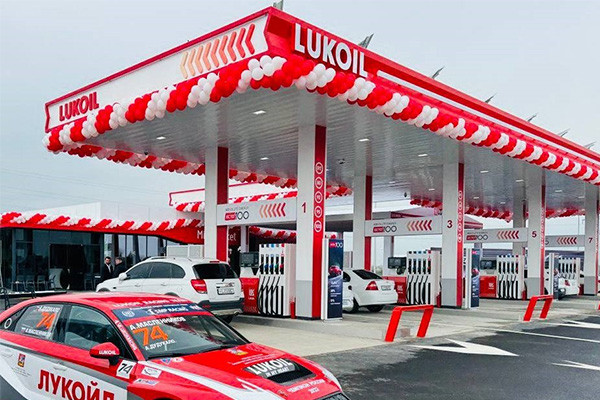
Tashkent, Uzbekistan (UzDaily.com) — Abu Dhabi National Oil Co. (Adnoc) is considering the acquisition of assets of the Russian oil and gas company Lukoil in Uzbekistan, which are currently under U.S. sanctions, Bloomberg reports.
According to the agency, American oil majors Exxon and Chevron are showing interest in Lukoil’s stakes in Iraq and Kazakhstan. At the same time, Lukoil itself plans to sell its foreign assets as a single package.
In Uzbekistan, Lukoil operates under production sharing agreements (PSAs) on the Kandym–Khauzak–Shady and Southwest Gissar projects, engaging in gas extraction and processing, and manages a network of filling stations. The company’s total investments in the country exceed US$10 billion, making it one of the largest foreign investors in Uzbekistan’s gas sector.
In October 2025, the U.S. Department of the Treasury announced new sanctions against Russian oil companies Rosneft and Lukoil, as well as their subsidiaries.
The restrictions cover 28 subsidiaries of Rosneft and six subsidiaries of Lukoil based in Russia.
https://www.uzdaily.uz/en/adnoc-shows-interest-in-lukoils-assets-in-uzbekistan/

Iran confirmed on Saturday that its Revolutionary Guards seized a Marshall Islands-flagged oil tanker as it traveled through the narrow Strait of Hormuz after it set sail from the UAE on the way to Singapore.
A report by the official IRNA news agency carried a statement by the Revolutionary Guard that said the tanker was taken to Iranian waters over alleged violations “for carrying unauthorized cargo.”
It said the seizure came following a court order, and the operation was aimed at “protecting Iran’s national interests and resources.” It identified the oil tanker as the Talara and said it was carrying 30,000 tons of petrochemical products.
The seizure happened on Friday. Tehran has been increasingly warning it could strike back after a 12-day war with Israel in June that saw the U.S. strike Iranian nuclear sites.
It said the ship had been en route to Singapore when Iranian forces intercepted it. A private security firm, Ambrey, described the assault as involving three small boats.
A U.S. Navy MQ-4C Triton drone had been circling above the area where the Talara was for hours on Friday observing the seizure, flight-tracking data analyzed by The Associated Press showed.
The British military’s United Kingdom Maritime Trade Operations center separately acknowledged the incident, saying a possible “state activity” forced the Talara to turn into Iranian territorial waters.
Cyprus-based Columbia Shipmanagement later said in a statement that it had “lost contact” with the tanker, which was carrying high sulphur gasoil. It did not immediately provide any update on Saturday.
Iran has been blamed for a series of limpet mine attacks on vessels that damaged tankers in 2019, as well as for a drone attack on an Israeli-linked oil tanker that killed two European crew members in 2021. Those attacks began after U.S. President Donald Trump in his first term in office unilaterally withdrew from Iran’s 2015 nuclear deal with world powers.
In 2022, Iran took two Greek tankers and held them until November of that year. Iran seized the Portuguese-flagged cargo ship MSC Aries in April 2024.
Years of tensions between Iran and the West, coupled with the situation in the Gaza Strip, exploded into a full-scale 12-day war in June.
Tehran has long threatened to close off the Strait of Hormuz, the narrow mouth of the Persian Gulf through which 20% of all traded oil passes. The U.S. Navy has long patrolled the Mideast through its Bahrain-based 5th Fleet to keep the waterways open.

Saudi Aramco is set to sign two major liquefied natural gas (LNG) supply agreements in the US next week with Woodside Energy and Commonwealth LNG, according to sources cited by Reuters.
These deals, expected to be finalized during Crown Prince Mohammed bin Salman’s visit to Washington, significantly advance Aramco’s ambition to become a dominant player in the global LNG market.
These transactions move Aramco closer to its target capacity of 20 million tonnes per annum (mtpa) of LNG, adding to the 4.5 mtpa already in progress, which includes a 20-year purchase agreement with NextDecade for 1.2 mtpa from the Rio Grande LNG project.
The new agreements would add up to 4 mtpa of US LNG supply to Aramco’s portfolio. Specifically, Aramco would secure up to 2 mtpa of LNG from Commonwealth LNG’s planned 9.5 mtpa facility in Cameron, Louisiana.
A parallel deal with Woodside Energy includes acquiring a stake in the company’s $17.5 billion Louisiana LNG project, alongside an offtake agreement for up to another 2 mtpa.
For Commonwealth LNG, the supply agreement is a critical step, bringing the company closer to selling its targeted 8 mtpa ahead of a final investment decision (FID) later this year. The company is developing the US’s first integrated LNG export facility. Woodside has already given final approval for its three-train, 16.5 mtpa project, scheduled to begin production in 2029.
According to Reuters, Aramco declined to comment on the potential deals. Woodside referenced an earlier collaboration agreement to explore joint opportunities, and Commonwealth LNG did not immediately respond to a request for comment.
https://egyptoil-gas.com/news/saudi-aramco-to-sign-4-mn-tpa-us-lng-deals-with-woodside-commonwealth/
Satellite images showing the aftermath of a combined attack on the Sheskharis oil export terminal in Novorossiysk confirm that key oil-pumping equipment was destroyed, forcing a suspension of oil exports.
The Exilenova+ Telegram channel published the satellite image.
According to the channel’s analysts, critical damage was inflicted on essential oil-handling infrastructure – including systems that measure oil quality and volume, as well as technological pipelines – at one of Russia’s largest oil export terminals.
“These components are among the most vulnerable in the entire facility. Damage to pipelines, loading racks, or pumping lines effectively shuts down any possibility of loading tankers, even if the storage tanks remain intact,” the analysts noted.
According to Suspilne’s sources within the Security Service of Ukraine, the attack damaged the oil-loading standers at the berths, the pipeline infrastructure, and the pumping units.
According to Reuters, the Russian port of Novorossiysk halted oil exports after Ukraine’s overnight attack on November 14. At the same time, Russia’s main pipeline operator, Transneft, was also forced to suspend crude oil deliveries to the port.
Satellite images from November 15 confirm that no vessels were docked at the oil terminal — a situation not seen during its normal operation.
According to industry sources cited by the outlet, in October, the volume of Russian crude oil transported through the Sheskharis terminal in Novorossiysk reached 3.22 million tonnes, or 761,000 barrels per day. Over the first ten months of the year, the figure totaled 24.716 million tonnes.

Satellite image of the port of Novorossiysk dated November 15, 2025. Photo credits: MT_Anderson
In addition to crude oil, 1.794 million tonnes of petroleum products were exported through Novorossiysk in October, and petroleum product exports for January–October totaled 16.783 million tonnes.
According to three industry sources, the Ukrainian attack affected two oil berths. Damage was inflicted on Berth 1 and Berth 1A, which service tankers with deadweights of 40,000 and 140,000 tonnes, respectively.
Two sources reported that the Arlan oil tanker, sailing under Sierra Leone flag, was also damaged during the attack. This vessel is part of the so-called “shadow fleet” and is under sanctions imposed by the United Kingdom, the EU, Switzerland, Canada, and Australia.
The General Staff of the Armed Forces of Ukraine reported that the strikes on targets in Novorossiysk were executed using Neptun cruise missiles and strike UAVs of various types.
By Irina Slav - Nov 17, 2025, 3:30 AM CS

China and India are buying more crude oil, providing some respite for producers facing expectations of oversupply, Bloomberg reported today, citing unnamed trading sources.
The two large importers have been buying mostly Middle Eastern cargos, the Bloomberg sources said, noting that these were being sold at a discount, with China the bigger buyer and India raising its purchases since the start of the month only marginally.
Purchases so far in November featured more Upper Zakum grade shipments and additional volumes of Kuwaiti crude, the publication reported. Indian refiners also bought West African crude and some Qatari crude.
“There is a lot of supply in the market,” Manoj Heda, executive director of international trade at India’s state-owned Bharat Petroleum, said at an industry event, as quoted by Bloomberg. But “demand centers are only limited to China and India.”
China and India are the biggest buyers of Russian crude, which is currently being squeezed by the latest U.S. sanctions, prompting the buying countries to look for alternatives. Last month, however, Indian oil buyers ramped up their intake of Russian crude ahead of the new sanction package’s entry into effect, Finland-based Centre for Research on Energy and Clean Air reported. The outlet tracks Russian energy exports on a monthly basis.
Per CREA figures, India imported some 3.1 billion euros, or $3.6 billion, worth of Russian energy commodities, with crude oil making up 81% of the total and oil products making up another 7%. The remainder of Russian energy imports was coal. Crude oil imports from Russia in October booked an 11% increase on September, with two-thirds of that total going to private refiners. State refiners in India also ramped up Russian energy commodity imports, buying almost twice as much of these in October as they did in September. China, meanwhile, remained the biggest buyer of Russian energy commodities last month, ahead of the sanctions.
By Irina Slav for Oilprice.com

The price of Russia’s flagship Urals crude at the Black Sea plunged to as low as $36.61 per barrel at the end of last week, the lowest in nearly three years, as the U.S. sanctions on the two biggest Russian producers and exporters, Rosneft and Lukoil, are slated to take effect from Friday.
On Thursday last week, the price of Urals loaded at the Novorossiysk port in the Black Sea slumped to $36.61 per barrel, before recovering slightly on Friday, according to data from Argus Media and Bloomberg. That’s the lowest Urals has traded since March 2023, when Russian crude prices plunged with the EU embargo on Russian crude oil imports.
The price of Urals loading from the Baltic Sea ports has also plummeted since the United States announced at the end of October sanctions on Rosneft and Lukoil. The sanctions sent Russia’s key buyers, China and India, scrambling for alternatives for fear of running afoul of the U.S. restrictions and being slapped secondary sanctions.
The discount of Urals at the Baltic Sea and Black Sea export terminals relative to the international Brent benchmark widened to an average of $23.52 a barrel at the end of last week, according to Argus data cited by Bloomberg.
The recent surge in the discount is the second time this year Urals has exceeded a $15 per barrel discount to Brent, after the Biden Administration’s last sanctions on Russia imposed in early January.
The widest discount was hit in 2022 and early 2023 – at over $30 per barrel below Brent, immediately after the Russian invasion of Ukraine and the introduction of a Russian oil embargo in the EU from 2023.
The widening discount of Urals will now weigh further on Russia’s oil revenues, the biggest budget income for the Kremlin to finance the war in Ukraine. October revenues for the Russian budget collapsed by 27% from a year earlier, as international oil prices dropped, sanctions on Russia intensified, and the Russian ruble strengthened.
By Michael Kern for Oilprice.com
https://oilprice.com/Energy/Crude-Oil/Russias-Oil-Price-Plummets-to-36-Per-Barrel.html
Middle East crude benchmark spot premiums of Oman, Dubai and Murban slid on Monday, having touched more than one-week lows in previous week, as the market continue to face ample supply pressures.
News of loadings resumed at the key Russian export hub of Novorossiysk after a two-day suspension due to a Ukrainian attack also eased some supply concerns and pushed down global oil benchmark prices on Monday.
SINGAPORE CASH DEALS
Cash Dubai's premium to swaps fell 13 cents to 78 cents a barrel.
Unipec and PTT will each deliver a January-loading Upper Zakum crude to Trafigura following the deals.
NEWS
Indonesian state energy firm PT Pertamina's 2025 oil and gas production is estimated at 1.03 million barrels of oil equivalent per day, chief executive Simon Mantiri said on Monday.
Indonesia's Chandra Asri Pacific TPIA said on Monday it has secured a bespoke $750 million financing package from investment firm to support its purchase of ExxonMobil's XOM Esso-branded retail fuel station network in Singapore.
Serbia secured a three-month licence from the U.S. to try to find a buyer for its Russian-owned oil company, NIS, which is under sanctions that threaten fuel supplies ahead of winter, energy minister Dubravka Djedovic-Handanovic said on Saturday.
The Trump administration on Friday gave clearance to potential buyers to talk to Russia's Lukoil about buying its foreign assets and allowed business dealings with Lukoil's Burgas refinery after Bulgaria moved to seize the plant.

In this post:
India has agreed to import almost 10% of Liquefied Petroleum Gas (LPG) from the U.S. in a historic first for organized U.S. energy sales to New Delhi. Indian Union Minister of Petroleum and Natural Gas Hardeep Singh Puri said on the X platform that the India-U.S. agreement aims to diversify India’s energy supplies.
He added that India seeks to address its trade surplus with the U.S. in the context of altering bilateral relations.
According to Singh Puri, the acquisition of LPG would use Mount Belvieu as the standard for LPG. Singh Puri revealed that over the previous few months, representatives from IndianOil, BPCL, and HPCL had traveled to the United States to discuss the deal with major producers.
India secures Historic U.S. LPG supply deal
Singh Puri stated that the discussions about the agreement ended today. He confirmed that Indian state-owned oil corporations have inked a one-year contract with the U.S. Gulf Coast to import around 2.2 million tonnes of LPG annually. Notably, he described the U.S Gulf Coast deal as “a historic first.”
According to Puri, the purchase of LPG would be the first structured contract of U.S. LPG for the Indian market.
Puri mentioned on the X platform that Prime Minister Narendra Modi, the head of the public sector oil companies in India, has made LPG available to consumers at a lower price. He revealed that Modi made sure that beneficiaries of the Ujjwala system continued to pay only ₹500–550 (US$6) per cylinder, despite the fact that global prices increased by more than 60% last year.
Puri further stated that the true cost of LPG was more than ₹1,100 (US$12.41). According to Puri, last year, the Indian government paid nearly ₹40,000 crore or approximately US$4.9 billion to protect consumers from soaring LPG costs abroad.
“We believe that this move is for diversifying our LPG sourcing, which is currently concentrated in the Middle East, and also to reduce trade surplus with the U.S.”
-Bineet Banka, Research Analyst at Nomura Financial Advisory & Securities.
According to Banka, India imports between 20 and 21 million tons of LPG yearly. Banka argued that if 10% of that supply comes from the U.S. at present prices, that means an additional $1 billion in imports from the U.S. However, Banka further claimed that the extra imports are “not much” in comparison to India’s $40 billion trade surplus with the U.S.
U.S.-India trade tensions escalate under Trump’s tariff actions
Relations between the U.S. and India have been tense since Washington levied a 50% tariff on Indian exports in August. According to a White House report, the U.S imposed a reciprocal duty of 25% on indian goods as part of a larger plan to improve domestic industries and correct trade imbalances. The remaining 25% was attributable to India’s imports of Russian oil.
President Trump stepped up his criticism of India in September, referring to trade ties with the country as “a totally one-sided disaster!”
Trump reiterated on his social media platform, Truth Social, that India was purchasing weapons and oil from Russia. According to data provided by tanker tracker Kpler, as of November 17, India’s imports of Russian crude oil remain at 1.85 million barrels per day, up from 1.6 million barrels in October.
However, Trump further accused New Delhi of selling the U.S. “massive amounts of goods” while placing high tariffs on American exports to India.
“The reason is that India has charged us, until now, such high Tariffs, the most of any country, that our businesses are unable to sell into India. It has been a totally one sided disaster!”
–Donald Trump, U.S. President.
In 2024, the World Trade Organization (WTO) Trade-weighted data reveal that India imposed a mean tax of 6.2% on U.S. imports. The data also reveal that the U.S. imposed a duty of 2.4% on Indian goods.
https://www.cryptopolitan.com/india-boosts-u-s-lpg-energy-imports/
Source: Xinhua| 2025-11-18 04:42:15| Editor: huaxia
CAIRO, Nov. 17 (Xinhua) -- Egypt's Petroleum Ministry said on Monday it has made a new natural gas discovery in the Western Desert, with initial tests showing a promising daily output of about 36 million standard cubic feet.
The discovery was made by Khalda Petroleum Company, a major operator in Egypt's energy sector, the ministry said in a statement.
The exploratory well, Gomana-1, was drilled after electric logs indicated substantial gas-bearing zones, it said. Testing and a preliminary assessment of the well's reserves are under way, and Khalda is working to bring the well into production within two days, according to the ministry.
The find is the latest in a series of discoveries by Khalda Petroleum and its international partner, Apache Corporation, as they continue to develop gas and oil resources in the Western Desert.
The ministry said the additional output will support Egypt's strategy to maximize domestic production and reinforce its role as a regional energy hub.
Egypt has been trying to boost its oil and gas production amid a decline in natural gas output in recent years. In August, Prime Minister Mostafa Madbouly said Egypt's current natural gas production stands at 4.1 billion cubic feet per day and is expected to rise to 6.6 billion cubic feet per day by 2027.
https://english.news.cn/africa/20251118/08361b1b792048c09a786cb08107fab3/c.html
US sanctions on Russian oil producers Rosneft and Lukoil, along with the European Union’s ban on refined products derived from Russian crude, are unlikely to materially affect the margins or credit profiles of India’s state-owned oil marketing companies, Fitch Ratings said, according to PTI. However, the agency said the eventual impact would depend on the duration and enforcement of the sanctions. Russian crude accounted for around one-third of India’s imports between January and August 2025, and discounts have contributed meaningfully to OMC profitability.
Fitch expects Indian refiners to comply with the sanctions, although some may continue sourcing unsanctioned grades. India sharply increased Russian crude intake after the February 2022 invasion of Ukraine, with discounted volumes lifting Russia’s share in India’s crude basket from under 1 per cent to nearly 40 per cent within months. Fitch said sanctions-related disruptions could suppress global demand for products linked to affected crude, potentially widening refined product spreads and helping refiners offset the loss of discounted Russian barrels. Those that continue processing unsanctioned Russian crude may benefit from deeper discounts.
The agency noted that global spare crude capacity should limit upward pressure on oil prices. It forecasts Brent at $70 in 2025 and $5 in 2026.Private refiners with exposure to EU markets may face greater compliance challenges, as crude origin becomes harder to trace when grades are blended. Such companies may adjust crude slates, redirect exports or invest in improved traceability systems.Indian OMCs posted EBITDA broadly in line with or slightly above expectations in the first half of FY26, supported by softer crude and robust gasoil spreads. Gross refining margins averaged $–7 per barrel, compared with $4.5–7 per barrel in FY25.Fitch expects GRMs to remain near mid-cycle levels of around $ per barrel in FY27, aided by firm domestic fuel demand and high utilisation rates.A government-approved ₹30,000 crore support package for Indian Oil, Bharat Petroleum, and Hindustan Petroleum in the second quarter of FY26 will help offset under-recoveries on subsidised LPG and strengthen liquidity, the agency said.Fitch added that the Issuer Default Ratings of all three OMCs remain supported by strong state linkages and a high likelihood of sovereign backing if required, PTI reported.

The American Petroleum Institute (API) has reported an increase in its weekly crude stock, reflecting a possible downturn in US petroleum demand. The latest data shows that the crude inventory level has risen to 4.4 million barrels.
This significant increase has exceeded market predictions, suggesting a bearish outlook for crude prices. Analysts had previously anticipated a more modest increase, given the previous week's reported inventory of 1.3 million barrels.
The 4.4 million barrels reported by the API is more than three times the previous figure. This sharp increase implies weaker demand for crude oil, gasoline, and distillates. The inventory data serves as a key indicator of the health of the US petroleum market, providing insights into both supply and demand dynamics.
The API's weekly crude stock data is closely monitored by market participants as it provides an early indication of the Energy Information Administration (EIA) data. The EIA report, which is more comprehensive and widely followed, is due to be released later this week.
The unexpected increase in crude inventories could potentially exert downward pressure on crude prices. If the trend continues, it could indicate a sustained period of weaker demand. Conversely, a decrease in inventories that exceeds market expectations could signal a bullish trend for crude prices, reflecting stronger demand.
In the short term, the increase in crude stock is likely to impact the sentiment of traders and investors within the oil market. The extent of this impact will be determined by a range of factors, including global economic conditions, geopolitical tensions, and changes in production levels.
The API will continue to monitor and report on the levels of US crude oil, gasoline, and distillates stocks, providing crucial data to help market participants make informed decisions. As always, the oil market will be closely watching for any signs of change in the supply-demand balance.
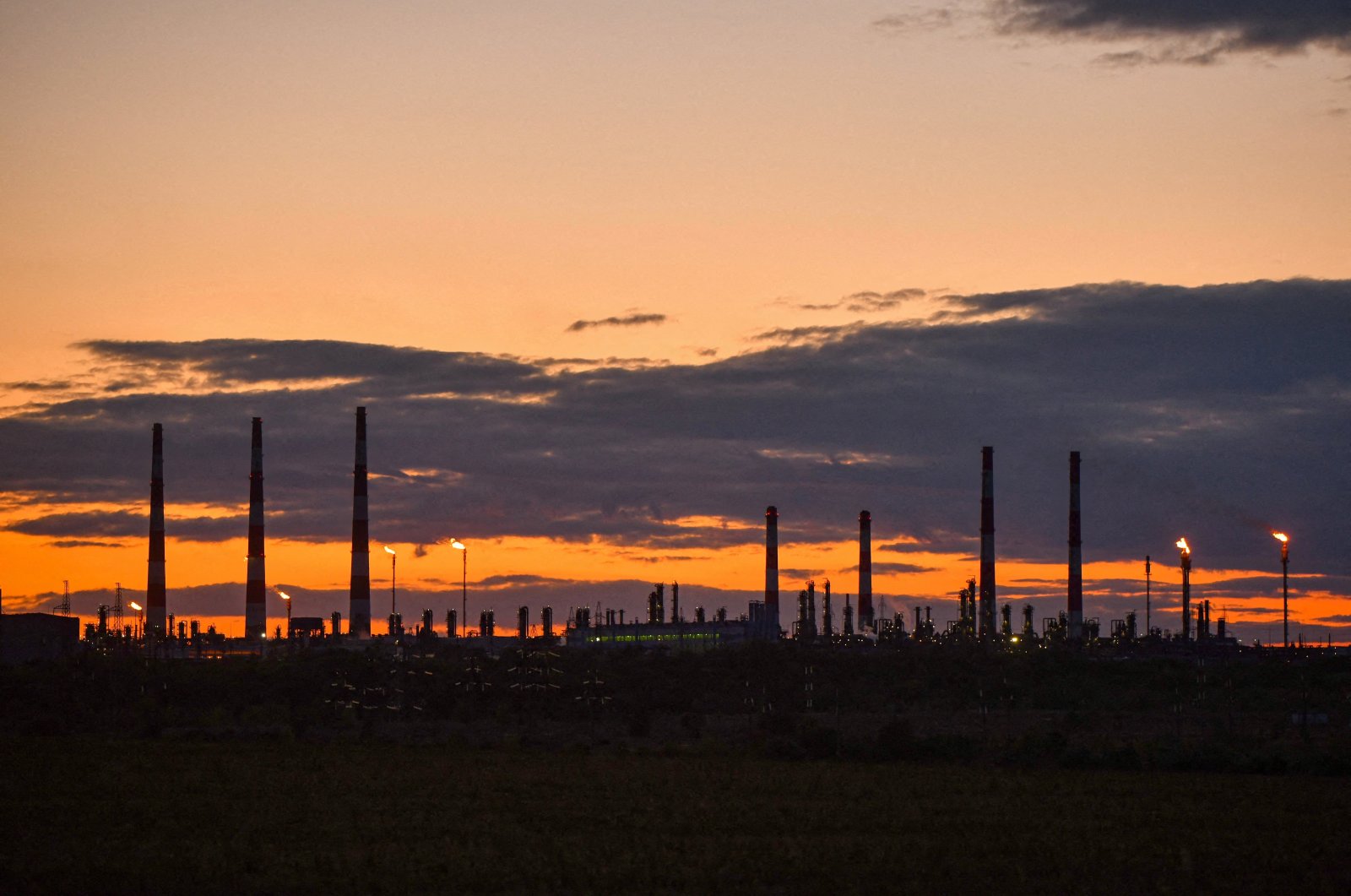
Turkish authorities late on Tuesday denied claims that Türkiye's recent liquefied natural gas (LNG) deal with the U.S. will end Russian gas imports, leading to an imminent energy crisis.
"Türkiye is one of the strongest countries in its region in terms of security of (energy) supplies, with its pipeline, LNG and storage infrastructure. There is no problem with the security of natural gas supplies or risk of an energy crisis today or for the coming winter period," the Directorate of Communications' Center for Combating Disinformation (DMM) said in a written statement on X.
Debunking the claims in some media reports, the center said they were "products of disinformation."
The statement also noted that Türkiye’s natural gas supply from Russia continues "uninterrupted and as planned within the framework of long-term contracts in force between the relevant institutions."
At the same time, it said the country’s procurement of pipeline gas and LNG from multiple sources, such as the U.S., Azerbaijan, Iran, Algeria, Oman and Qatar, "is a technical preference aimed at diversifying supply security, increasing competition and strengthening the flexibility of supplies."
Russia remains Türkiye's largest gas supplier, but its share of the market has fallen from more than 60% two decades ago to 37% in the first half of 2025, according to Reuters. Most European countries halted imports following Moscow's invasion of Ukraine in 2022.
Ankara has often reiterated that it aims to increase the diversity of its supply and benefit from global LNG abundance while also boosting its push for domestic gas and oil production, alongside renewable capacity expansion. It is also planning to start production of electricity from its first nuclear power plant, developed by Russia's Rosatom, next year.
At the same time, the country has positioned itself to become a regional gas trading hub, and its state-run energy firm BOTAŞ has already signed deals to supply Hungary and Romania with small volumes of gas.
In September, Türkiye signed a 20-year deal with trading company Mercuria to buy U.S. liquefied natural gas.
The Trump administration has pushed countries like India to halt energy purchases from Russia – while trying to corner the Kremlin in peace talks with Kyiv – slapping it with additional tariffs, which have tested Washington-New Delhi ties.
Türkiye is the second-largest importer of seaborne Russian Urals crude after India, according to LSEG data. It has not joined Western sanctions against Russia but complies with international laws and restrictions.
It is also a major mediator in the ongoing conflict between Russia and Ukraine.
Alaska LNG, majority owned and developed by Glenfarne Alaska LNG, LLC (Glenfarne), and Baker Hughes have announced a strategic alliance to advance the Alaska LNG Project, US.
Glenfarne has selected Baker Hughes as its supplier for main refrigerant compressors for the LNG terminal and power generation equipment for the North Slope gas treatment plant. Baker Hughes has also committed to a strategic investment to support Alaska LNG. The agreements were announced in a ceremony in Washington, D.C., with US Secretary of the Interior Doug Burgum and Secretary of Energy Chris Wright.
“Baker Hughes is pleased to support Alaska LNG with our gas technology solutions,” said Lorenzo Simonelli, Chairman and CEO of Baker Hughes. “Natural gas and LNG provide secure, affordable, and reliable energy, and we look forward to continuing our collaboration with Glenfarne to bring lower-carbon natural gas from Alaska to the global market.”
“Baker Hughes is a welcome partner for Alaska LNG because of their leadership in LNG compression technology,” said Brendan Duval, CEO and Founder of Glenfarne. “Their participation reflects Alaska LNG’s momentum and its ability to attract global partners to achieve national and state energy objectives.”
Glenfarne is developing Alaska LNG in two financially independent phases to accelerate project execution. Phase One consists of an 807-mile, 42-in. pipeline to transport natural gas from Alaska’s North Slope to meet Alaska’s domestic energy needs. Worley is expected to complete final engineering and cost analysis for the pipeline in December leading into a final investment decision (FID) on this phase of the project.
Phase Two of the project will add the LNG terminal and related infrastructure to enable 20 million tpy of LNG export capability and is expected to declare FID in late 2026.
Glenfarne became lead developer of Alaska LNG in March. Since then, Glenfarne has secured preliminary commercial commitments with leading LNG buyers in Japan, Korea, Taiwan, and Thailand for 11 million tpy of LNG, more than 60% of the volume needed to reach FID, including recent agreements with Tokyo Gas, JERA Co. Inc. and POSCO International Corp.
Glenfarne’s permitted North American LNG portfolio totals 32.8 million tpy of capacity across projects in Alaska, Texas, and Louisiana. The companies previously announced that Baker Hughes will supply compression equipment for Glenfarne’s Texas LNG project.
Russia has decided to sell its stake in the Serbian oil and gas company NIS amid US sanctions. This was stated by the Minister of Energy of Serbia, Dubravka Đedović-Handanović, noting that it concerns 56.15% of the shares, but the name of the buyer has not yet been disclosed. This is reported by UNN.
Details
The majority of NIS shares are currently controlled by Gazprom Neft – 44.85%, another 29.87% belongs to Serbia. 11.30% of the shares are owned by the St. Petersburg JSC "Intelligence", managed by Gazprom Capital, the remaining share is distributed among minority shareholders.
In early 2025, Washington added NIS to the list of prohibited companies. On October 9, 2025, NIS officially announced the entry into force of American sanctions. After that, as reported, the US insisted on Russia's complete withdrawal from the company's shareholders.
The sale of the Russian stake could be a key step in reducing sanctions pressure on the Serbian energy sector.
https://unn.ua/en/amp/moscow-agreed-to-sell-its-stake-in-serbian-company-nis-after-us-sanctions

By Enes Tunagur and Robert Harvey
LONDON — Oil prices fell sharply on Wednesday after a report of a U.S. proposal to end the Russian war in Ukraine and as oversupply concerns continued to weigh on prices.
Brent crude futures fell $1.72, or 2.65%, to $63.17 a barrel by 1421 GMT after gaining 1.1% the previous session.
U.S. West Texas Intermediate crude futures were down $1.65, or 2.72%, at $59.09 after rising by 1.4% on Tuesday.
Ukraine has received “signals” about a set of U.S. proposals to end the war, which Washington has discussed with Russia, a senior Ukrainian official told Reuters on Wednesday.
Ukrainian President Volodymyr Zelenskiy will hold talks in Turkey on Wednesday and meet U.S. Army officials in Kyiv on Thursday in a new drive to revive peace negotiations with Russia.
Successful peace talks would reduce oil supply risks, said Saxo Bank analyst Ole Hansen.
Russian Deputy Prime Minister Alexander Novak said that U.S. sanctions against Rosneft and Lukoil, imposed in October after peace talks stalled, have had no impact on Russian oil output.
The U.S. Treasury said on Monday that sanctions now squeezing Russia’s oil revenue are expected to curb its export volumes. Crude buyers in China and India have already started switching to alternative suppliers.
Those sanctions come into full effect on November 21 when a U.S. Office of Foreign Assets Control (OFAC) wind-down licence ends, except for assets given separate operating licences.
“There is maximum pressure right now as Friday’s deadline is looming,” said Rystad Energy oil analyst Janiv Shah, adding that a lower geopolitical risk premium would leave investors focusing more closely on weak market fundamentals.
Supply glut in focus
The risk of a supply glut continued to weigh on prices along with falling gasoil futures after strong gains in recent sessions, Saxo Bank’s Hansen added.
U.S. crude stocks rose by 4.45 million barrels in the week ended November 14 while gasoline inventories climbed by 1.55 million barrels and distillate stocks grew by 577,000 barrels, market sources said late on Tuesday, citing American Petroleum Institute figures.
Inventory data from the U.S. Energy Information Administration (EIA) is due later on Wednesday.
https://journalrecord.com/2025/11/19/oil-prices-fall-us-peace-proposal-ukraine-oversupply/
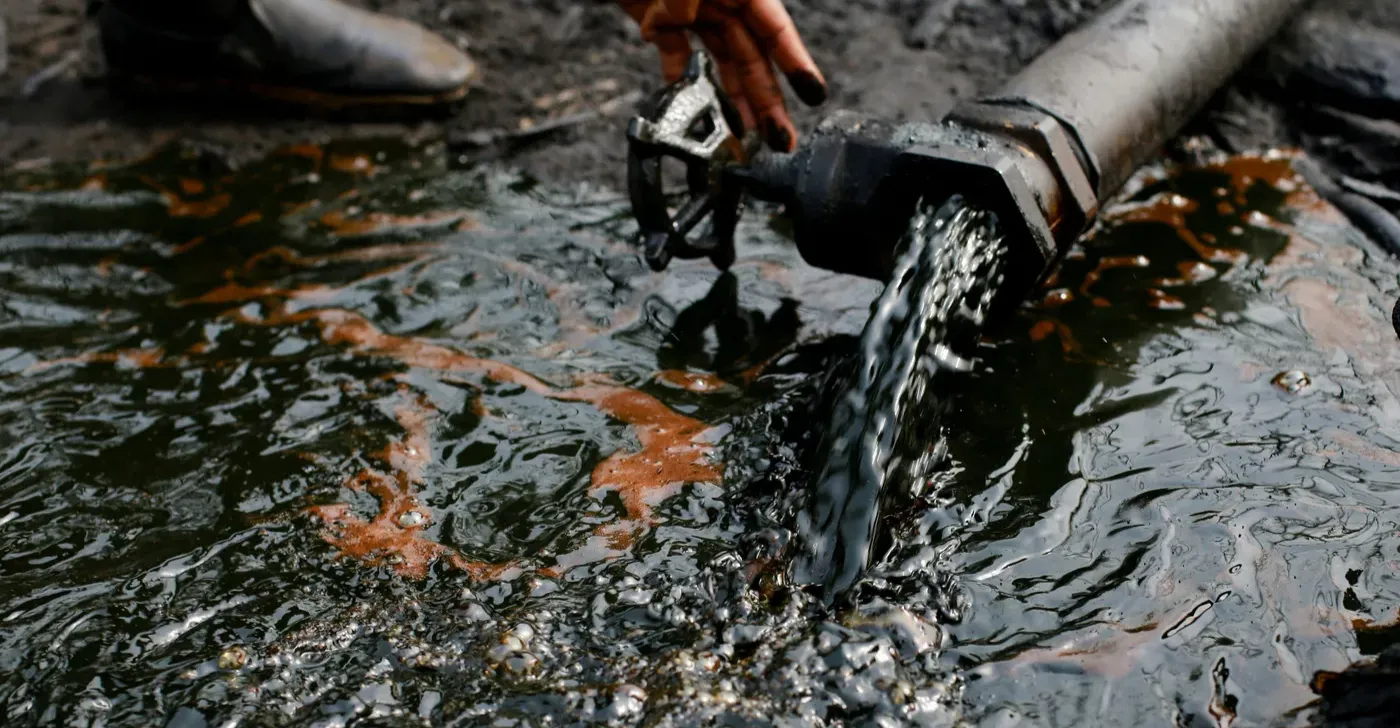
Oil prices edged up on Thursday after falling in the previous session as concerns a U.S. push to end the Russia-Ukraine war may add supply into an amply supplied market were offset by a bigger-than-expected draw in U.S. crude stockpiles.
Brent crude futures climbed 16 cents, or 0.25%, to $63.67 a barrel at 0338 GMT, while U.S. West Texas Intermediate crude futures rose 17 cents, or 0.29%, to $59.61.
Both benchmarks slightly rebounded after falling 2.1% during Wednesday's session. The movement followed a Reuters report that the U.S. had signalled to Ukraine to accept a U.S.-drafted framework to end the war with Russia by giving up territory and some weapons, citing two sources familiar with the matter.
Prices dropped on concerns an end to the war would end sanctions on Russian crude sales, releasing that supply onto the market at the same time oil is being stored on tankers and major producers have increased their output quotas.
In a note on Thursday, analysts at ING cautioned that Ukraine is unlikely to back the plan as they could see it favouring Russia but "signs that the U.S. is still trying to work on a deal eases some concerns over further sanctions against Russia and also how strongly current curbs will be enforced."
Lending some support to prices was the bigger-than-expected draw in U.S. crude stockpiles reported on Wednesday, which reflected rising refining runs amid good margins in the world's biggest oil consumer, and export demand for U.S. crude.
Crude inventories fell by 3.4 million barrels to 424.2 million barrels in the week ended November 14, the EIA said, compared with analysts' expectations in a Reuters poll for a 603,000-barrel draw.
That said, analysts also pointed out that gasoline and distillate stockpiles in the U.S. built for the first time in over a month, a sign of slowing consumption.
The market is also awaiting the impact of a November 21 deadline set by the U.S. for companies to wind down their business with Rosneft (ROSN.MM) and Lukoil (LKOH.MM), Russia's two biggest oil producers and exporters.
The companies were sanctioned as part of U.S. efforts to end the Russia-Ukraine war.
https://shafaq.com/en/Economy/Brent-WTI-rebound-after-2-1-drop-aided-by-EIA-data

The $5-billion East African Crude Oil Pipeline (EACOP), which is planned to export crude oil from Uganda via a port in Tanzania, is now 75% complete, moving landlocked Uganda a step closer to becoming an oil exporter.
EACOP, a controversial pipeline project that has seen a lot of environmental opposition and planning and construction delays, is now about three-quarters completed, according to the Petroleum Authority of Uganda (PAU) as quoted by Reuters.
With pipeline construction progressing, Uganda now aims to begin oil production from its oilfields in its Albertine rift basin in the west in the second half of 2026.
The EACOP project is for a 1,443-kilometer-long (897 miles) pipeline to be built from landlocked Uganda to the Tanga port in Tanzania. The oil pipeline is expected to bring crude from the Lake Albert project in Uganda to the international oil market. It is designed to transport 216,000 barrels of crude oil per day, with a ramp-up of up to 246,000 bpd, Uganda says.
EACOP shareholders are France’s supermajor TotalEnergies with a 62% stake, Uganda National Oil Company Limited (UNOC) with 15%, Tanzania Petroleum Development Corporation (TPDC) holding another 15%, and CNOOC, the state oil giant of China, with an 8% interest.
The Lake Albert region in Uganda is estimated to hold more than one billion barrels of oil and gas resource equivalent. Uganda wanted to develop them under the projects Tilenga, operated by TotalEnergies, and Kingfisher by CNOOC.
Addressing environmental concerns, TotalEnergies has said that both the Tilenga project and the East Africa Crude Oil Pipeline are among its lowest-emission operations, with an average Scope 1 and 2 intensity of 12 kilograms of CO2 equivalent per barrel of oil equivalent. The total carbon dioxide emissions of both over their lifetime are calculated by the company at 13.5 million tons.
By Tsvetana Paraskova for Oilprice.com
This is reported by Bloomberg
Following the new U.S. sanctions and the likely seizure of Russian assets in the form of oil refineries in Bulgaria – and probably also in Serbia – there is a perception of diminished Putin’s influence in the Balkans after Russia’s full-scale invasion of Ukraine.
Analysts note that the push to expel Russian oil giants out of the region helps reduce the Kremlin’s ability to conduct lobbying activities and other forms of interaction with the political and business elites of the Balkans, thereby reducing its influence in the region.
In Bulgaria, the government took control of the assets of the Russian oil giant Lukoil and Neftohim, depriving shareholders of rights and appointing a manager to negotiate a potential sale. The parliamentary committee needed only 26 seconds to overturn 26 years of Russian ownership.
Serbia: The Path to Possible State Control Over NIS
In Belgrade, authorities aim to avoid full nationalization, but are considering options to buy Naftna Industrija Srbije AD (NIS), which is under the control of Gazprom. It is also known that NIS lost oil supply last month after the expiration of several U.S. sanctions exemptions. The Serbian oil refinery has reserves of about a week, after which the government may tap into reserves or seek crude resources at high prices, increasing the likelihood that President Aleksandar Vučić will decide the plant’s future. He noted that the corresponding decision must be found by November 23.
The Balkans in the Context of European Strategy and Global Sanctions
The situation underscores growing pressure on the region from European policy: the EU cannot ignore pressure for Serbia to join sanctions against Russia. Experts also note that effective U.S. steps against the Russian oil sector erode the Kremlin’s economic ability to sustain influence in the Balkan region. Together with continued sanctions against Russian assets, this will affect Belgrade’s and Sofia’s energy decisions and shape a new balance of power in the region.
In sum, the situation in the Balkans demonstrates how global sanctions mechanisms affect local energy: from indirect pressure on supply chains to potential decisions on state control over strategic assets. Depending on how the governments of Bulgaria and Serbia use their positions, the region may move toward greater autonomy from Russian influence or face new challenges in its energy system.
https://mezha.net/eng/bukvy/us-sanctions-reduce-russian-influence-in-balkans-oil-sector/amp/
13 November 2025
Rio Tinto Group has mothballed its $2.95 billion Jadar lithium project in Serbia, Bloomberg reported, according to the Serbian Economist.
The project will be transferred to “care and maintenance” mode in accordance with plans to simplify Rio Tinto’s asset portfolio and focus on more interesting opportunities in the short term, the document said.
A company spokesman confirmed to the agency the decision to mothball Jadar, which has large lithium-rich ore reserves.
The project, which never reached the production stage, faced many problems. The Serbian government has repeatedly changed its position on the issue of granting permits to develop the mine, which was strongly opposed by local communities.
“Given the lack of progress on the issue of permits, we can no longer maintain the previous level of expenditure and resource allocation,” the document said.
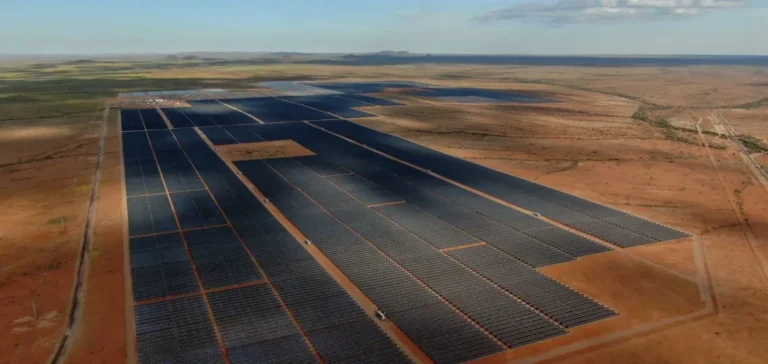
Chinese group PowerChina is strengthening its hydroelectric, solar and gas projects across the African continent, aiming to raise the share of its African revenues to 45% of its international activities by 2030.
State-owned Power Construction Corporation of China (PowerChina) has announced its intention to significantly expand its presence in the renewable energy sector in Africa. The company plans to extend its hydroelectric, solar and gas projects across the continent as part of a strategy to diversify its energy portfolio and reinforce its international revenues.
Regional growth target by 2030
According to statements from a PowerChina representative at an economic summit in Johannesburg, African revenues currently account for around 30% of the company’s international operations. The group aims to increase this figure to between 40 and 45% by 2030. PowerChina is targeting commercial presence in nearly all African markets over the next five years, relying on a mix of ongoing developments and completed infrastructure.
Project deployment across multiple markets
In South Africa, PowerChina is developing several photovoltaic projects and participating in the construction of the Redstone concentrated solar power plant. The company has also contributed to the development of the Adama wind farm in Ethiopia and designed the hybrid Oya project to stabilise electricity production from intermittent sources. This project is considered a pilot that could be replicated in other markets.
Focus on industrial and mining projects
In Zambia, PowerChina delivered a 100MW solar plant in June intended to supply the operations of First Quantum Minerals, a major copper producer. This installation is part of a series of projects designed to meet the growing energy demand of extractive industries on the continent.
An investment strategy despite an evolving financial context
The decline in Chinese loans to African governments since 2016 has not hindered PowerChina’s engagement on the continent. The company is now prioritising targeted partnerships, taking into account regulatory requirements and the economic viability of its projects. The group states that its African expansion will rely on cooperation with local authorities and the private sector to ensure long-term profitability of renewable energy operations.
https://energynews.pro/en/powerchina-accelerates-its-investments-in-renewable-energy-in-africa/
By Felicity Bradstock - Nov 15, 2025, 4:00 PM CST

United States President Donald Trump is putting his money where his mouth is as he doubles down on efforts to accelerate the expansion of the country’s nuclear energy sector. The government will spend billions in public funding to reinvigorate U.S. nuclear power, following decades of underinvestment. Unlike renewable energy, Trump views nuclear power as key to expanding the U.S. electricity generation capacity and recently announced the target of quadrupling nuclear capacity by 2050.
In May, President Trump signed an executive order calling for the U.S. to develop 10 new large nuclear reactors by the end of the decade. In addition, several tech companies, including Alphabet, Amazon, Meta Platforms, and Microsoft, are providing billions in private funding to restart old nuclear plants, upgrade existing ones, and deploy new reactor technology to meet the growing demands from the data centres powering advanced technologies, such as artificial intelligence.
The U.S. Department of Energy’s (DoE) loan office will dedicate significant funds to the nuclear energy industry to support the development of new reactors. This week, the Energy Secretary Chris Wright stated, “We have significant lending authority at the loan programme office… By far the biggest use of those dollars will be for nuclear power plants — to get those first plants built.”
Wright expects the public support for the sector to encourage private actors to invest more heavily in nuclear power in the coming years. “When we leave office three years and three months from now, I want to see hopefully dozens of nuclear plants under construction,” said Wright.
In October, Trump came to an agreement with the owners of Westinghouse – uranium miner Cameco and Brookfield Asset Management – to invest $80 billion to build nuclear plants across the country. Westinghouse plans to construct large nuclear plants to be fitted with its modern AP1000 reactor design, which can power over 750,000 homes, according to the company. Cameco COO Grant Isaac suggested he would look to the DoE’s loans office to fund the development of the Westinghouse reactors.
However, critics are not so certain that Westinghouse will be able to deliver on its promises due to the company’s poor track record. The firm went bankrupt in 2017 after going over budget on large-scale nuclear projects in Georgia and South Carolina. Westinghouse will have to prove its ability to build the AP1000 on time and on budget to attract the investment it requires.
The Trump administration has developed various international partnerships to help develop its nuclear power sector in recent months. In September, Japan committed to investing in the Westinghouse nuclear project. The Asian country also agreed on an investment deal for Hitachi GE Vernova to build small modular reactors (SMRs).
Also in September, the U.S. signed a multibillion-dollar deal with the United Kingdom to expand nuclear power across both countries. The new Atlantic Partnership for Advanced Nuclear Energy is aimed at accelerating the construction of new reactors and providing reliable, low-carbon energy for high-demand sectors, such as data centres.
The question now is, just how long will it take to achieve the U.S. nuclear renaissance? It typically takes a decade or longer to develop a new nuclear power plant, and while adding additional reactors to existing plants can be faster, licensing and approval can take several years. In addition, after decades of stagnation in the sector, developing nuclear reactors in the U.S. can be extremely costly and slow, due to the lack of expertise, compared to rapidly growing nuclear powers, such as China.
In China, developing a new nuclear reactor now takes between five and six years on average, much faster than the decade-long timeline in most Western countries. This is supported by China’s strong regulatory system and tried-and-tested development methods. Meanwhile, in the U.S., just powering up a disused reactor, such as that of Three Mile Island, can take several years to achieve. The projects being funded by tech companies, which focus on the development of SMRs, are not expected to produce power until the next decade, and these are much smaller than conventional reactors.
The Trump administration hopes to speed up the development process through a range of measures. One executive order calls for the nuclear power industry’s safety regulator to approve applications in no more than 18 months. The recent funding announcement from the DoE’s loan office is expected to help overcome the biggest bottleneck – funding. Congress has also kept its tax breaks in place for nuclear development to attract private funding to the sector.
Thanks to greater political support and public financing, the U.S. nuclear energy sector could rapidly expand its power capacity over the coming decades. However, achieving the level of acceleration in nuclear development expected by the Trump administration is highly unlikely due to a range of challenges hindering development, from expertise to cost and manufacturing capacity. So, while a nuclear renaissance is possible, it is unlikely to be seen within the next decade.
https://oilprice.com/Alternative-Energy/Nuclear-Power/Trump-Bets-Big-on-a-Nuclear-Comeback.html
China purchased at least 14 cargoes of U.S. soybeans on Monday, marking the largest single buying spree since January and the most significant since the October summit between President Donald Trump and President Xi Jinping in Busan, South Korea.
Sana Khan - November 18, 2025
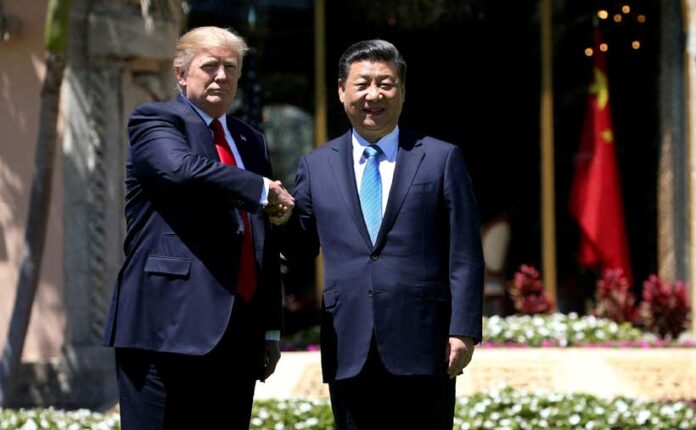
U.S. President Donald Trump (L) and China's President Xi Jinping shake hands while walking at Mar-a-Lago estate after a bilateral meeting in Palm Beach, Florida, U.S., April 7, 2017. REUTERS/Carlos Barria/File Photo
China purchased at least 14 cargoes of U.S. soybeans on Monday, marking the largest single buying spree since January and the most significant since the October summit between President Donald Trump and President Xi Jinping in Busan, South Korea. The move comes as China seeks to fulfill pledges made to the U.S. at the summit, despite paying significantly higher prices than rival Brazilian offers. The deals, arranged by China’s state-owned grain trader COFCO, cover shipments from both the U.S. Gulf Coast and Pacific Northwest ports for December and January deliveries, totaling at least 840,000 metric tons.
Why It Matters
The purchases signal China’s commitment to honoring its trade promises to the U.S., despite a history of sourcing soybeans from cheaper suppliers like Brazil and Argentina during the trade war. For American farmers, this represents a vital boost, pushing U.S. soybean futures to a 17-month high and easing pressure on an agricultural sector battered by low prices and high input costs. Strategically, the deals demonstrate that trade commitments made at high-level summits can translate into concrete market shifts, influencing global commodity flows and pricing.
Key stakeholders include U.S. soybean farmers and exporters, who stand to benefit from renewed Chinese demand; COFCO and other Chinese buyers, which are paying premium prices to meet political commitments; and rival exporters, particularly in Brazil and Argentina, whose competitive pricing is currently undercut by geopolitical considerations. U.S. trade negotiators also have a stake, as the sales are a tangible outcome of diplomatic efforts to ease trade tensions.
What’s Next
Further purchases are likely as China continues to meet its commitment of 12 million metric tons for the year. The premium pricing may influence U.S. soybean markets in the near term, sustaining higher futures and cash premiums. Exporters will monitor whether the political imperative behind these purchases continues to outweigh cost considerations, and whether this renewed demand will stabilize U.S. farm incomes or encourage long-term shifts in global soybean trade patterns.

Summary
Nov 19 (Reuters) - President Donald Trump's administration is considering delaying for one or two years its proposed cuts in incentives for imported biofuels amid pressure from U.S. refiners who argue the move could raise costs and tighten fuel supplies, according to two sources familiar with the matter.
The delay now under discussion could please domestic oil refiners that have invested in the bio-based diesel sector but would risk frustrating U.S. farmers and biofuel producers.
The proposal for the Environmental Protection Agency to slash the value of renewable fuel credits given by the U.S. government for imported biofuels was initially pitched this year as part of Trump's "America First" energy agenda, aimed at boosting domestic production and reducing reliance on foreign supply, and was meant to take effect Jan. 1.
The Environmental Protection Agency is now weighing a plan to delay implementation of that proposal until 2027 or 2028, the sources told Reuters, speaking on condition of anonymity.
The EPA said it is reviewing public comments ahead of issuing final rules in the coming months. The agency declined to comment on whether it is considering a delay. The White House did not respond to requests for comment.
Big Oil, led by the influential American Petroleum Institute industry group, had argued that limiting credits for foreign supply could constrain availability and push fuel prices higher - an outcome the White House is eager to avoid as affordability remains a central political concern heading into next year's congressional elections.
Under the proposed cuts in credits for imports, the EPA would allocate only half as many tradable renewable fuel credits to imported biofuels and biofuel feedstocks as to domestic ones. The shift has significant implications for bio-based diesel, which relies on imports to meet federal mandates.
The decision on a possible delay is one of several high-profile regulatory moves by the administration that the fuel industry is closely watching.
Others include finalizing 2026 biofuel blending mandates, determining whether to allow year-round sales of gasoline blended with 15% ethanol, or E15, and deciding how or whether to require larger refiners to compensate for exempted gallons under the small refinery waiver program.
The protracted U.S. government shutdown and efforts to resolve a logjam of small refiner requests for exemptions from U.S. biofuel laws have also contributed to delays in resolving regulatory moves related to biofuels, the sources said.

Global cocoa prices plunged to multi month lows this week as softening demand from chocolate manufacturers overshadowed lingering supply worries, even as chocolate confectionery remains the fastest rising grocery category in the United Kingdom.
Cocoa futures on the Intercontinental Exchange (ICE) New York fell sharply on Wednesday, with December contracts closing down 319 points at a 6.06% decline. December ICE London cocoa dropped 256 points, representing a 6.32% fall. The declines pushed prices to their lowest levels since February 2024 on the nearest futures chart, with New York cocoa trading around $4,943 to $5,345 per tonne depending on contract month.
The weekly price movement reflects approximately a 3% to 4% decline across both major exchanges, reinforcing what analysts describe as a bearish, consumption driven correction. Market observers attribute the slump to weakening demand rather than any sudden improvement in supply conditions.
Structural risks affecting cocoa production, including ageing trees, disease pressure, and rainfall variability in West Africa, remain in play but have not escalated in recent days. Weather conditions across the region showed no significant anomalies over the past seven days, meaning meteorological factors did not contribute to this week’s price movement.
The demand led sell off comes amid encouraging signals from major growing regions. Chocolate maker Mondelez International recently reported that the latest cocoa pod count in West Africa stands 7% above the five year average and materially higher than last year’s crop. Ivory Coast farmers have expressed optimism about the quality of the upcoming main crop harvest, which is expected to begin next month.
Adding downward pressure, European Union (EU) nations are pushing for a one year delay to the EU Deforestation Regulation (EUDR), which was scheduled to take effect in late December. The regulation aims to restrict imports of commodities including cocoa from regions where deforestation occurs. A postponement would ease supply concerns and allow continued imports from parts of Africa, Indonesia, and South America.
Cocoa’s extraordinary volatility over the past year has tested the global chocolate industry. Futures prices peaked above $12,000 per metric tonne in late 2024, more than quadrupling from the $2,000 to $3,000 range typical of the preceding decade. The surge prompted major manufacturers to revise earnings forecasts and sparked discussion about alternatives such as carob as a cocoa substitute.
Despite retreating from those record highs, elevated raw material costs continue to squeeze chocolate manufacturers’ margins. Grindings, a measure of demand from processors, remain subdued in key processing regions, with evidence suggesting that some consumers are trading down or reducing premium chocolate purchases.
Fraser McKevitt, head of retail and consumer insight at Worldpanel by Numerator (formerly Kantar), noted that British supermarkets are intensifying promotional activity as the Christmas season approaches. Discounted spending rose 9.4% year on year in October, with nearly 30% of all grocery purchases made through promotions. He noted that retailers are emphasising price cuts rather than multibuy offers as they compete for footfall.
UK grocery sales reached 35.26 billion pounds in the 12 weeks to 2 November, representing 4% year on year growth. Take home sales in the four week period grew 3.2%, though this figure trails the 4.7% inflation rate, indicating that volumes declined in real terms.
Among grocery categories, chocolate confectionery leads price increases alongside fresh meat and coffee, while household paper, sugar confectionery, and pet food prices continue falling. The persistence of chocolate inflation reflects the lagged impact of earlier cocoa price spikes working through supply chains.
The macroeconomic backdrop provides further justification for cautious sentiment. Weak global economic growth continues to weigh on discretionary spending, while high interest rates in major consuming markets have crimped household budgets. Processors report subdued sentiment and are moderating bean purchases in response.
UBS has reduced its cocoa price forecast by $1,750 per metric tonne across its forecast horizon, citing weakened demand conditions. Analyst consensus suggests prices are likely to ease further next year from current elevated levels, though not as sharply as futures curves currently imply.
West Africa, which supplies over 70% of the world’s cocoa, faces ongoing structural challenges. Ivory Coast’s mid crop is projected at 400,000 metric tonnes, down 20% from historical norms due to weather extremes, swollen shoot virus, and poor bean quality.
For the short term, market analysts anticipate neutral to slightly bearish conditions, with demand weakness the dominant driver and supply stable. Medium term upside risks persist should West African weather shift abruptly, disease impact yields, or export disruptions emerge. However, softening consumption currently outweighs supply concerns, leaving cocoa trading like a demand sensitive asset rather than a scarcity commodity.
https://www.newsghana.com.gh/cocoa-prices-tumble-as-weak-global-demand-outpaces-supply-concerns/
Nov 17, 2025 7:32 PM EST
Key Points
Gold prices have retreated recently, raising questions about whether we are nearing the end of the yellow metal’s impressive rally this year.
After surging to all-time highs near $4,400 per ounce in October, the precious metal retreated below $4,000 per ounce in late October. Since then, it has bounced around, trading between $3,900 and $4,205, before closing at $4,054 on November 17.
The recent action has left gold bugs wondering if they should “buy the dip” in gold or sell to lock in profits.
Annual gold returns since 2020:
Dip buyers appear to be holding the line below $4,000, but gold remains down 7.4% over the past month. That’s hardly reassuring, but Goldman Sachs has recently revisited its gold price outlook for 2026, highlighting one major catalyst that is likely to determine the next move in prices.
Gold surges in 2025 as yields fall, Dollar dips
The U.S. economy is performing well, based on GDP growth; however, considerable cracks, in the form of unemployment and inflation, have emerged that have boxed in the Federal Reserve.

The jobs market is creating fewer new jobs than it was in 2024, according to payroll processor ADP. Layoffs are surging, and unemployment has risen to its highest level since 2021. Meanwhile, President Donald Trump’s tariff strategy has increased import costs, leading to a rise in inflation.
In August, the Bureau of Labor Statistics reported that the unemployment rate was 4.3%, up from 3.4% in July. Challenger, Gray, & Christmas data show U.S. employers have announced 1.1 million layoffs this year through October, up 44% from the same period in 2024.
According to a study by Resume.org, four out of 10% companies laid off workers in 2025, and 60% expect to cut workers in 2026.
Meanwhile, the Consumer Price Index, or CPI, showed inflation was 3% in September, up from 2.3% in April, before most tariffs went into effect.
The jobs and inflation data put the Fed in a precarious position because its dual mandate is low unemployment and inflation, and these two goals often run contrary to one another.
Still, the Fed reduced interest rates by a quarter percentage point at its FOMC meetings in September and October, and many expect it to continue supporting the jobs market into 2026.
In addition to concerns over jobs and inflation, the U.S. economy also faces a significant headwind from its debt, as well as worries that foreign central banks’ appetite for financing our spending might wane.
The backdrop has caused Treasury yields to fall and the U.S. Dollar to decline. The 10-year Treasury yield is 4.14%, down from 4.77% in early January. The U.S. Dollar Index has dropped to 99.5 from 109 over the period.
That’s been good for gold because, historically, gold prices tend to move in the opposite direction of yields and the dollar. Lower Treasury yields make them less attractive as a safe-haven alternative to gold, and because gold is priced in U.S. Dollars, Dollar weakness makes gold more affordable to foreign buyers, including central banks.
Goldman Sachs revisits 2026 gold forecast
The recent volatility in gold prices has occurred as Treasury yields have risen from below 4% to their current levels. The Dollar has also contributed to gold’s recent drop, rising about 1% in the past month.
Still, Goldman Sachs thinks that the catalysts underpinning gold will continue to offer support, making the pullback relatively short-lived, particularly given that central banks remain buyers.
“The gold price broke higher last week, jumping about $25 in a vertical move during last Monday’s Asia hours and rising nearly 6% before correcting on Friday to just under $4,100. The timing, size and speed of last Monday’s price increase are consistent with Asian central bank buying,” wrote Goldman Sachs analysts in a research report provided to clients and shared with TheStreet.
The top investment bank, which was founded 156 years ago, has seen its share of gold booms and busts. It says central bank buying has accelerated and will continue strong into next year.
“Our GS nowcast estimates central bank purchases at 64 tonnes for September (vs. 21 tonnes in August), and central bank buying likely continued in November. We continue to see elevated central bank gold accumulation as a multi-year trend, as central banks diversify their reserves to hedge geopolitical and financial risks,” wrote the analysts.
Goldman Sachs estimates central banks will buy a monthly average of “80 tonnes in 2025Q4-2026.” The bank estimates that Qatar bought 20 tonnes of gold in September, Oman acquired 7 tonnes, and nd China bought 15 tonnes.
Overall, the pace of buying by central banks led Goldman Sachs to stick to its forecast that gold prices will climb to $4,900 by end-2026. It also says that prices could wind up even higher if trends by retail investors to include gold in portfolios continue.
“The pickup in central bank buying, together with the largest monthly gold Western ETF inflow (112 tonnes) since mid-2022, marks the first time in this cycle that strong post-2022 central bank demand and such a sizable increase in ETF holdings have occurred simultaneously,” wrote the analysts.
https://www.thestreet.com/investing/goldman-sachs-revisits-gold-price-forecast-for-2026
By ZeroHedge - Nov 18, 2025, 12:00 PM CST

One year ago, Goldman's precious metal analyst Lina Thomas made the case that gold would rise to $3000 by the end of 2025 (it ended up rising more than $1000 higher) as a result of relentless central bank purchases in general, and thanks to China's ravenous appetite for gold in particular. The bank promptly got pushback on this thesis, with skeptics countering that it is unlikely that gold will manage to keep its ascent at the same time as the dollar rises to new record highs, one of the largest consensus Trump trades.
In response, Thomas also - correctly - pushed back, writing that she disagrees with the argument that "gold cannot rally to $3,000/toz by end-2025 in a world where the dollar stays stronger for longer", for four reasons:
And while it took less than a year for gold prices to surge far above the bank's (in retrospect) conservative forecast, there was one aspect of the prediction that was already playing out: as we showed at the time using an analysis of central bank and other institutional gold buying on the London OTC market, China was secretly buying up 10x more gold than it admits.
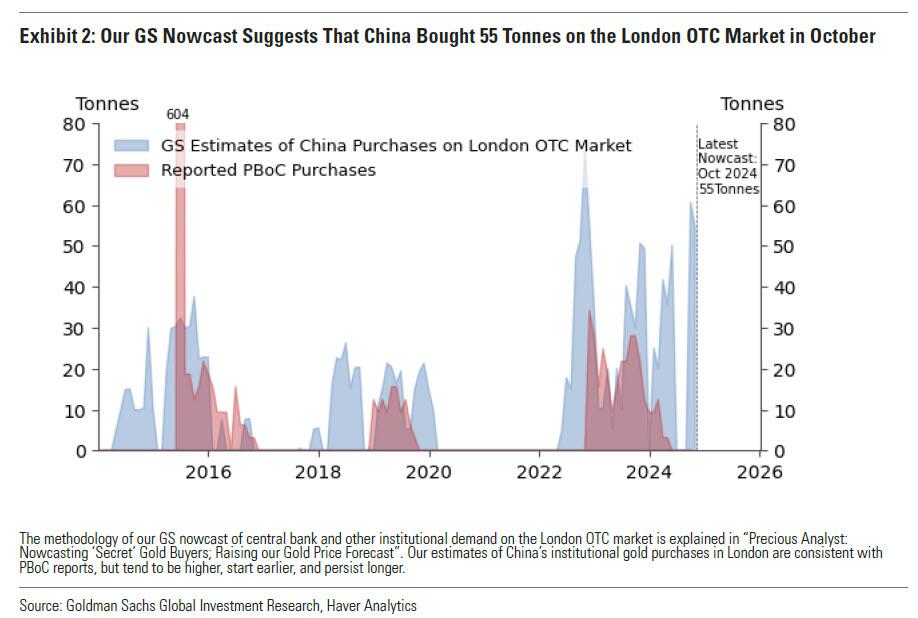
A few months later we repeated this observation: China continued to secretly buy 10x more gold (27 tonnes) than it reports (3 tonnes).
While that alone was sufficient to validate the bullish thesis, another key factor that also emerged was the aggressive ramp up of gold ETF purchases by retail investors, something we predicted over a year ago...
... and which Morgan Stanley confirmed over the weekend had been a "big support for gold this year."
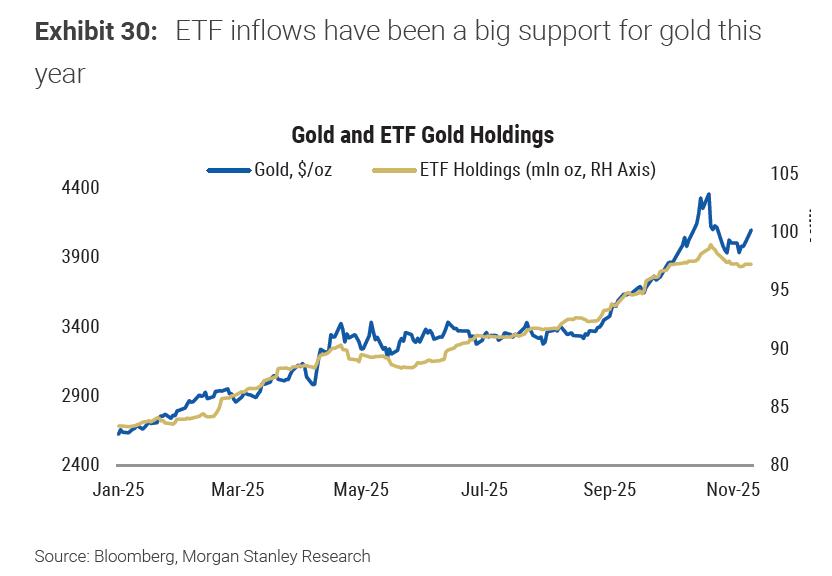
But while ETF purchases come and go as price momentum ebbs and flows, in retrospect the biggest shocker was our revelation that - in keeping with tradition - China was secretly buying up most of the available gold in the open market (presumably in anticipation of some major event which has yet to be unveiled). Needless to say, there was tremendous pushback to this claim, with the "serious" strategists balking at the possibility that China would be allocating its precious reserves to a barbarous relic.
Not any more: fast-forwarding to one year later when over the weekend, the FT reported that "China’s actual gold purchases could be more than 10 times its official figures as it quietly tries to diversify away from the US dollar, highlighting the increasingly opaque sources of demand behind bullion’s record-breaking rally." Or precisely what we said last December.
The FT notes that publicly reported buying by China’s central bank has been so low this year - 1.9 tonnes purchased in August, 1.9 tonnes in July and 2.2 tonnes in June - that few in the market believe the official figures. Instead, echoing the same trade data analysis we did back in 2024 (and ever since), the newspaper points to work done by analysts at Société Générale who estimate that China’s total purchases could reach as much as 250 tonnes this year, or more than a third of total global central bank demand.
The scale of the country’s unreported purchases highlights the growing challenges facing traders trying to work out where prices go next in a market increasingly dominated by central bank purchases.
“China is buying gold as part of their de-dollarisation strategy,” said Jeff Currie, chief strategy officer of energy pathways at Carlyle, who says he does not try to guess how much gold the People’s Bank of China is buying.
“Unlike oil, where you can track it with satellites, with gold you can’t. There’s just no way to know where this stuff goes and who is buying it.”
And since official Chinese data is unreliable at best, or simply fake, traders had turned to alternative sources of data to gauge demand, such as orders for freshly cast 400oz bars with consecutive serial numbers, which are typically refined in Switzerland or South Africa, shipped via London and flown to China, for evidence of the country’s purchases. The same analysis we have been doing since 2022.
“This year, people are really not believing the official figures, especially about China,” said Bruce Ikemizu, director of the Japan Bullion Market Association, who believes China’s current gold reserves are nearly 5,000 tonnes, double the level it publicly reports.
Of course, China is not alone: ever since the US weaponized the dollar in response to the Ukraine war, Central banks have been buying up huge quantities of bullion fuelling a rally that has pushed the price above $4,300 per troy ounce.
This accumulating has been so relentless, that gold’s share of global reserves outside the US has climbed from 10% to 26% over the past decade, World Gold Council data shows, making it the second-largest reserve asset after the dollar. Yet fewer and fewer of these purchases are being reported to the IMF, which collects data voluntarily.
In the most recent quarter, only about one-third of official buying was publicly reported, down from about 90% four years ago, according to WGC estimates based on Metals Focus data.
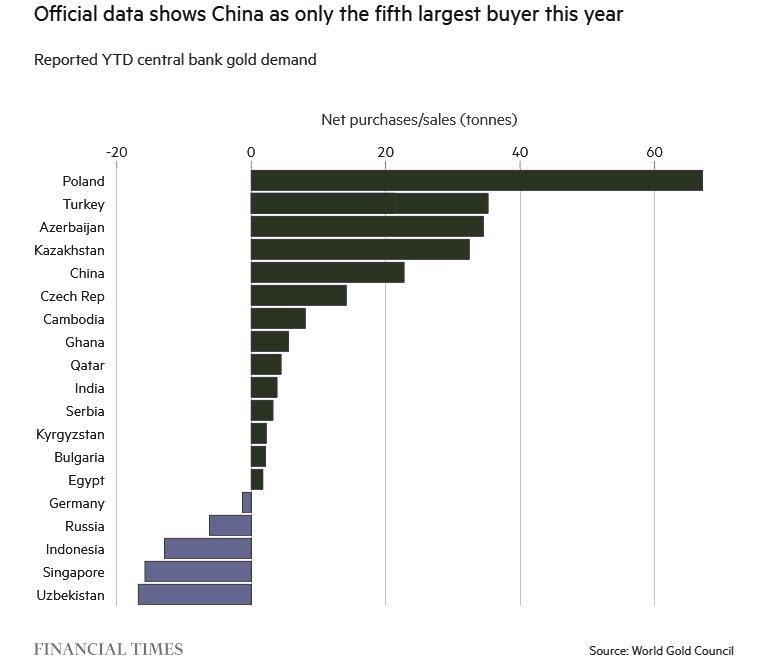
Central banks may choose not to report their gold activity to avoid front-running the market or for political reasons. Some fear that publicly buying bullion, which is often a hedge against the dollar, could worsen relations with the Trump administration.
“It makes sense to just report the bare minimum, if need be, for fear of reprisal from the US administration,” said Nicky Shiels, analyst at Swiss refinery MKS Pamp. “Gold is seen as a pure USA hedge. In most emerging markets it is in central banks’ interest to not fully disclose purchases.”
At the same time, sellers are also keen not to move prices against themselves by announcing their intentions. Former UK chancellor Gordon Brown’s well-publicized statements in 1999 that the Bank of England would sell half its gold reserves helped push prices even lower, and the sale yielded just $275 per ounce on average, about one-fifteenth of today’s price.
Michael Haigh, an analyst at Société Générale, said this opacity made the gold market “unique and tricky” compared with commodities such as oil, where Opec plays a role in regulating production.
“What is different with gold is that the tonnage going in and out of central banks is so impactful. Without having clarity on that, it is a bit more of an issue.”
And while China is the world’s biggest producer and consumer of gold, it is also the least transparent, leaving analysts to run their own numbers based on import data, guesswork and tips.
Its official gold-buying program, which is managed by the State Administration of Foreign Exchange, part of the People’s Bank of China, has officially bought just 25 tonnes this year. Reserve gold is typically stored either in Shanghai or in Beijing. And yet, applying the same proxy we used one year ago, namely looking at UK gold exports to China (as the PBOC favors large bars which are mainly traded in London), SocGen estimates that Safe will import about 250 tonnes this year, or 10x more. This number sure sounds familiar...
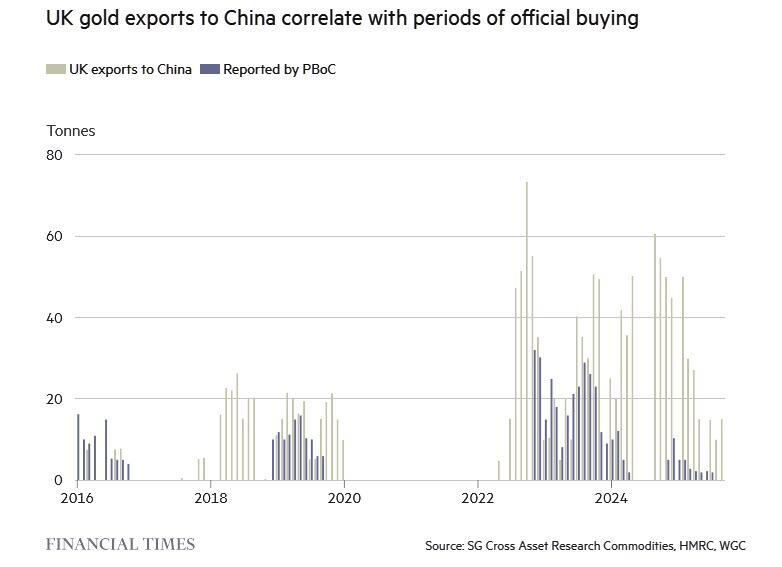
Another method is to calculate the gap between China’s net imports and domestic gold production, and the change in the amount held by commercial banks or purchased by retail consumers. Using this method, Plenum Research, a Beijing consultancy, calculates a “gap” attributable to official buying of 1,351 tonnes in 2023 and 1,382 tonnes in 2022, more than six times the public purchases China made in those years.
But while the actual numbers are unclear, one thing is certain: China will buy much more gold than it officially reports. Safe has one-year and five-year targets for its purchases of gold, and current official holdings remain far below target, according to a former Safe official. The purchases are made not only by Safe and its intermediaries, but also by China’s sovereign wealth fund CIC and the military, which are not mandated to disclose their holdings on a timely basis.
Complicating the picture is China’s status as the world’s largest gold miner, accounting for 10% of global production last year, which means that it also has the option of buying bullion domestically for its reserves. But in a geopolitical statement of force, as China expands its gold holdings, it is also courting developing nations to store it in the country. As BBG recently reported, Cambodia recently agreed to place newly purchased gold, paid for in renminbi, in the Shanghai Gold Exchange’s vault in Shenzhen.
In light of all these variables, many gold analysts will not even hazard a guess as to the true scale of purchases by the PBoC.
“It’s ultimately unknowable,” said Adrian Ash, research director of BullionVault, an online trading platform. “Any apparent route to figuring it out . . . misses the problem that it is only one part of the enigma wrapped in the riddle which is China’s bullion market.”
One thing is clear: it will keep rising.
In a note published earlier today Lina Thomas (and available to pro subs), the Goldman gold analyst who correctly calculated China's true purchases over a year ago, she writes that the bank's latest gold nowcast estimates that central bank purchased 64 tonnes for September vs. 21 tonnes in August, and central bank buying likely continued in November: "We continue to see elevated central bank gold accumulation as a multi-year trend, as central banks diversify their reserves to hedge geopolitical and financial risks. We maintain our assumption of average monthly central bank buying of 80 tonnes in 2025Q4-2026", Thomas wrote.
The gold price broke higher last week, jumping about $25 in a vertical move during last Monday’s Asia hours and rising nearly 6% before correcting on Friday to just under $4,100. The timing, size and speed of last Monday’s price increase are consistent with Asian [ZH: read Chinese] central bank buying, which often appears in London prices around Asian trading hours and thus sees an initial decrease in the Shanghai-London price premium but is then often followed by delayed momentum buying in retail China and then the West.
We continue to see elevated central bank gold accumulation as a multi-year trend as central banks diversify their reserves to hedge geopolitical and financial risks.
Our GS nowcast of central bank and institutional gold demand on the London OTC estimates September purchases at 64 tonnes (67 tonnes on a 12-month moving-average basis), up from 21 tonnes in August and consistent with the typical post-summer seasonal acceleration
Goldman estimates that September purchases were led by the Middle East - Qatar at 20 tonnes and Oman at 7 tonnes - and China at 15 tonnes, extending the trend of massively underreporting its actual purchases (the official number was roughly 10% of that estimate).
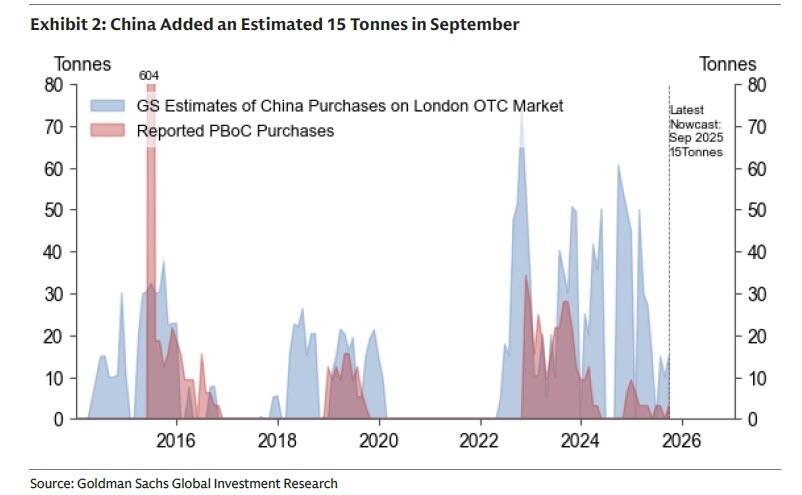
Goldman concludes that the pickup in central bank buying, together with the largest monthly gold Western ETF inflow (112 tonnes) since mid-2022, marks the first time in this cycle that strong post-2022 central bank demand and such a sizable increase in ETF holdings have occurred simultaneously, something we predicted back in 2024. Thomas believes that this combination, alongside likely additional off-ETF physical buying by ultra-high net worth individuals, as well as the ongoing buying spree by Tether which is increasingly diversifying into gold alongside T-bills, likely contributed to September’s 10% rally, the strongest monthly increase in gold prices since 2016.
Going forward, Goldman expects continued central bank buying, alongside private investor flows under Fed easing, to lift gold prices to $4,900 by end-2026, and predicted even more "significant upside" if the private investor diversification theme gains more traction.
Newmont Mining US6516391066

The world's largest gold producer finds itself at the center of significant market speculation. Newmont Mining is simultaneously advancing a major copper development project while industry observers ponder whether the company might be positioned to acquire the world's most valuable gold mining operations from competitor Barrick Gold.
Newmont approaches these potential strategic moves from a position of financial strength. The company's robust cash flow, supported by favorable gold prices and disciplined cost control, provides a solid foundation for substantial investments. October's quarterly results notably exceeded analyst projections, demonstrating the company's capacity to fund both large-scale projects and potential acquisitions.
Adding to the dynamic landscape, Newmont will undergo a leadership transition at year's end. Current CEO Tom Palmer is retiring, with COO Natascha Viljoen slated to become the first woman to lead the global gold mining giant. Market participants are watching closely to see how her leadership might influence the company's strategic direction.
Major Copper Investment in Papua New Guinea
Newmont is aggressively pursuing its copper strategy through the Wafi-Golpu project in Papua New Guinea, a joint venture with Harmony Gold. Recent estimates indicate this massive undertaking could require an investment of up to $5 billion, highlighting its strategic importance to the company's future.
This focus on copper aligns with broader industrial trends. The metal is increasingly essential for global energy transition technologies, spanning applications from electric vehicles to power grid infrastructure. Through Wafi-Golpu, Newmont aims to establish itself not merely as a gold mining leader but as a significant participant in the future copper market.
Potential Shift in Nevada Gold Operations
Meanwhile, developments involving competitor Barrick Gold could create acquisition opportunities. Activist investor Elliott Management has taken a position in Barrick, leading to market speculation about potential changes to the Nevada Gold Mines joint venture.
Key details of the current arrangement:
- Barrick maintains a 61.5% controlling interest in Nevada Gold Mines
- Newmont holds the remaining 38.5% stake
- The joint venture represents the world's largest gold mining complex
- Full control by Newmont would represent a substantial strategic achievement
Industry analysts suggest Elliott Management might pressure Barrick to divest its entire stake in the Nevada operations to Newmont. Such a transaction would significantly alter the global gold mining landscape and potentially deliver one of the industry's most valuable assets to Newmont's portfolio.

South African billionaire Patrice Motsepe.
Harmony Gold, South Africa’s largest gold producer, backed by Patrice Motsepe, Africa’s first Black billionaire, is weighing a major copper venture in Papua New Guinea with U.S. miner Newmont Corporation, Motsepe said Tuesday.
“There’s a huge investment that we are currently looking at in Papua New Guinea,” Motsepe said at a Bloomberg event. “We’ve got a partnership there with Newmont that might require as much as four or five billion dollars to be invested down the line.”
Large-scale project under review
Motsepe said Harmony’s finances are strong enough to support a project of that size. The company holds R13 billion ($754.8 million) in cash and has access to another R7 billion ($406.4 million) in credit lines.
He said the group expects to allocate a sizeable share of that capital to Australia and Papua New Guinea, where copper prospects remain central to future growth. Shareholders, he added, expect Harmony to pursue opportunities in those regions.
The potential investment in Papua New Guinea aligns with rising demand for metals needed in the global shift toward cleaner energy systems, Motsepe said.
Expanding across regions and minerals
African Rainbow Minerals, which Motsepe founded and which is one of Harmony’s key investors, will continue to invest in gold, platinum group metals, iron ore and manganese in South Africa. It also maintains a copper position in Canada.
Founded in 1950, Harmony operates mines in South Africa, Papua New Guinea and Australia. Its copper portfolio in Australia has grown in recent years, anchored by the Eva Copper Project, which aims to produce up to 60,000 tonnes of copper annually once operational.
Motsepe holds an 11.8 percent stake in Harmony through African Rainbow Minerals. He has been a key backer since the company’s merger with Avmin in 2003. The recent MAC Copper acquisition marks another step in Harmony’s effort to broaden its international presence.
Revenue lift and latest acquisition
Harmony reported revenue of R73.9 billion ($4.3 billion) in its latest financial year , up from R61.4 billion ($3.56 billion) previously, supported by a 27 percent rise in the average gold price to R1.53 million ($88,810) per kilogram.

Barrick Mining Restructures Leadership as Elliott Takes Stake and Acquisition Talk Rises
Barrick Mining Corp. is undertaking a sweeping management overhaul as the Canadian gold producer faces mounting speculation about a potential acquisition or corporate breakup.
According to an internal letter to employees from newly appointed chief executive officer Mark Hill—reviewed by Bloomberg—the company is implementing significant leadership changes and revising its regional operating model. Two senior managers and a top executive are departing as part of the restructuring.
The move comes shortly after activist investor Elliott Investment Management LP acquired a substantial stake in Barrick. The firm has been under pressure following operational setbacks and cost overruns that left it lagging behind competitors despite soaring gold prices.
Barrick has also been troubled by the seizure of a key mine in Mali and three fatalities this year. Former CEO Mark Bristow abruptly stepped down in September.
Hill is initiating the restructuring as reports circulate that Barrick is evaluating a potential breakup, including the possibility of splitting into two publicly listed companies. Last month, Bloomberg reported that Newmont Corp. examined a deal that would give it control of both companies’ highly valued Nevada assets.
In his letter, Hill described Barrick’s recent safety record as “deeply concerning” and its operational performance as “inconsistent.”
“While the fundamentals of our company are excellent, we cannot continue to operate in this way,” Hill wrote. The changes, he added, are intended to better align the operating model with strategic priorities and concentrate leadership where it can have the greatest effect.
Barrick declined to comment on the developments.
As part of the reorganization, the company will integrate its Dominican Republic operations into its North American division and merge its Latin American and Asia-Pacific regions into a single operating unit.
Several senior personnel changes were also announced. Kevin Thomson, head of corporate development, has left the company, as have Christine Keener, chief operating officer for North America, and Kevin Annett, North American chief financial officer. Their roles will be filled by George Joannou, Tim Cribb, and Wessel Hamman, respectively.
Hill also revealed that Barrick’s major Pakistan copper project, Reko Diq, will operate under its own leadership structure due to its scale. Chad Coulin will serve as project director, while Gui Recena Costa will lead the consolidated Latin American operations.
Despite recent challenges, Barrick’s shares have risen 119% over the past year—though this remains below the average 131% gain among its peers as investors increasingly turn to gold amid concerns over government debt and shifts in central bank reserve strategies.
GOLD and SILVER rallied again Thursday, reversing the drop made yesterday on better-than-expected US trade data plus news that the Federal Reserve is unlikely to cut interest rates in December, as delayed jobs data for September put US unemployment at a 4-year high.
After cutting US interest rates in October, "Many participants suggested that, under their economic outlooks, it would likely be appropriate to keep the target range unchanged for the rest of the year," said minutes of that Fed meeting released Wednesday, confirming 'hawkish' Fed comments made since.
August's US imports of goods and services were $59.6 billion greater than its exports, the Bureau of Economic Analysis said yesterday, close to the smallest monthly trade deficit since the fall of 2020, thanks to a sudden stop in gold bullion imports.
"Total nonfarm payroll employment has shown little change since April," said the Bureau of Labor Statistics today, reporting net jobs growth of 119,000 for September − news also delayed by the US government shutdown − and putting the unemployment rate 1 tick higher than August at 4.4%, the highest since October 2021.
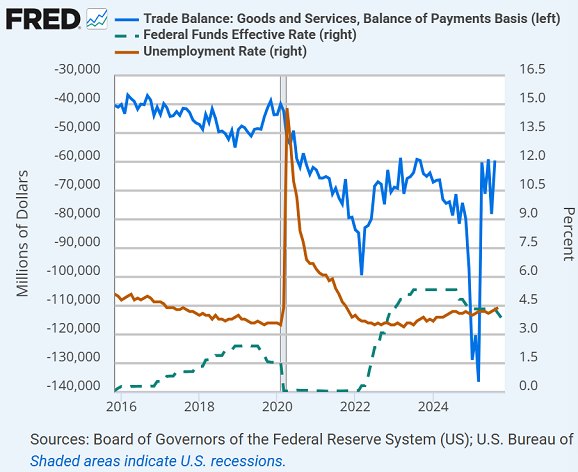
Betting in the futures market today put 44% odds on a December rate cut from the Fed, up from yesterday's plunge to 30% but still contrasting with traders' near-unanimous 'dead-cert' view of a month ago.
Gold topped $4100 per Troy ounce on Thursday for the 4th time this week, trading exactly where prices stood at this point in October.
Silver meantime dropped over $2 per ounce from Wednesday's peak above $52 but then rallied to $51.25, trading 6.8% higher from one month ago.
Global stock markets rose for a 2nd session after the plunge in AI hyperscalers and crypto tokens saw the MSCI World Index record its longest stretch of losses since spring 2024, while industrial commodities such as crude oil and copper traded little changed, as did longer-term borrowing costs in the bond market.
With Western financial news focused on Beijing's "true" gold reserves while analysts point to China's larger-than-reported US Dollar reserves as well, sanctioned neighbor Russia − now discussing a 28-point peace plan proposed by the Trump White House but as yet rejected by Ukraine − says its central bank is growing gold-trading activity for Moscow's National Wealth Fund.
In contrast to today's BLS figures, US payrolls fell by 32,000 in September according to the private-sector ADP estimate, followed by growth of 42,000 in October.
August's sharp drop in US gold bullion imports came amid confusion over the White House's tariffs policy for bullion bars − confusion which wasn't dispelled until President Trump declared that "Gold will not be tariffed!" the following month.
https://www.bullionvault.com/gold-news/gold-price-news/gold-fed-unemployment-112020251

The European Union and Zambia signed a 50 million-euro funding agreement this week to upgrade the Livingstone-Ndola railway. The deal strengthens Zambia’s position in the race to develop key logistics corridors in Southern and Eastern Africa.
The financing will modernize key sections operated by Zambia Railways and overhaul signalling systems. It adds to existing European and US support for the Lobito Corridor, which is viewed as one of the most competitive mineral transport routes on the continent.
The Lobito rail project aims to provide a faster route for exporting copper and cobalt from Zambia and the Democratic Republic of Congo through Angola’s Atlantic coast. Many analysts see the initiative as a Western counter to China’s growing influence over regional infrastructure.
China deepened its longstanding presence in the region last September when it approved 1.4 billion dollars to modernize the TAZARA railway, which links Zambia to the Tanzanian port of Dar es Salaam. The TAZARA upgrade, one of the largest China-Africa cooperation projects, is expected to restore the corridor’s role as a major export route to the Indian Ocean.
At the same time, Zambia is considering a third option with a planned rail corridor involving Zambia, Zimbabwe and Mozambique. The initiative aims to improve access to the Mozambican ports of Beira and Maputo, reflecting Lusaka’s effort to diversify its logistics routes.
Analysts say the growing wave of investment reflects a geopolitical and economic race among major powers seeking secure access to copper and other critical minerals that are abundant across the region. Zambia itself aims to raise national copper output to 3 million tonnes a year by 2031, underscoring its increasing importance in global mineral supply chains.
Henoc Dossa

Posted on 17 Nov 2025
Industrial technology major Emerson has announced that global mining company South32 has chosen its advanced automation solutions and engineering expertise to support the zinc deposit of the Hermosa mine project in Arizona.
The multi-million-dollar automation project will deploy integrated remote operations systems for South32’s first ‘next generation mine,’ enabling the production of critical minerals while minimising environmental impact.
Global demand for zinc, silver and lead is forecast to rise roughly 10-25% by 2035, driven by industrial growth, electrification and renewable energy expansion. The Hermosa project will produce those critical metals and others to support transportation infrastructure, battery production, construction, defence technologies, solar energy and corrosion-resistant steel manufacturing for a low-carbon future.
Emerson’s advanced software enables key efficiencies to be designed into South32’s Centro, its remote operations centre, currently under construction about 30 miles from the mine site. Centralised control software, asset management systems, smart field devices and remote operations technologies will be integrated to improve safety, efficiency and environmental performance. Centro is a commercial, office-style facility that will host approximately 200 full-time staff to remotely monitor and operate underground and surface equipment.
“The Hermosa project represents the kind of forward-looking investment that drives both economic growth and energy security,” said Ram Krishnan, Chief Operating Officer of Emerson. “By combining advanced automation with a commitment to environmental responsibility, South32 is setting a new standard for sustainability and innovation in mining.”
Emerson says its DeltaV™ automation platform will help make this possible by gathering real-time data from across the mine into a single secure control system. Operators will remotely monitor and optimise key systems – from ore handling to power and water usage – while running a fully digital, low-emission mining operation.
Caltrol, Emerson’s Impact Partner in the region, will support the project with expert service and maintenance, ensuring rapid response, consistent engineering standards and emergency support.
South32 is a Perth-based, globally diversified mining and metals company with operations in Australia, India, China, Japan, the Middle East, Mozambique, the Netherlands, Brazil, South Africa, South Korea and the United States.
https://im-mining.com/2025/11/17/emerson-selected-to-automate-south32s-hermosa-project/
Base Metals
Copper: Copper prices fell as a slightly firmer dollar and broader macro concerns weighed on prices. Benchmark three-month copper on the LME was down 0.5% at $10,802. There is little change regarding narrative on copper, with markets eyeing upcoming data out of the US for clues on Fed direction and for signs of economic activity. Sentiment has recently been weighed down by disappointing data out of China, where recent industrial data has been uninspiring even as major infrastructure and green energy investments support long-term demand. Speculation has been growing that Beijing will target the copper refining industry in its drive to reduce overcapacity, following calls from China’s nonferrous metals association for tighter oversight of new smelting projects. The cash LME copper contract last traded at an $18-a-ton discount to the three-month forward, indicating no pressing need for short-term metal.
Zinc: Zinc was up 0.1% to $3,023. The zinc cash contract is seeing a $208 premium, underscoring supply tightness amid low LME stocks of less than 40,000 tons.
Aluminum: Aluminum fell 0.9% to $2,833.
Tin: Tin slipped 0.1% to $36,750.
Lead: Lead dropped 0.7% to $2,050.
Nickel: Nickel shed 1% to $14,740.
Precious Metals
Gold: Gold prices moved lower in muted activity as investors await clues on Fed policy ahead of a delayed September jobs report due on Thursday, while PMI data due Friday will also shine some light on current economic conditions. Fed Funds futures are showing less than a 50% chance of a September rate cut from the Fed, down significantly from just over a month ago, as several Fed officials have voiced concerns for cutting rates in December. September’s report will likely stir volatility, although it will come up short of being reflective of the state of the labor market given that the report is two months old. Accurate and reflective figures likely will not come until early January, when December’s report is due, and those figures could also be distorted due to the shutdown as well.
The Fed will also publish its meeting minutes from October on Wednesday, which could offer clues regarding how many members would support a rate cut in December. Markets will continue to look to private figures for clues to the state of the US economy. S&P PMI data out Friday is likely to gain attention, especially in regard to its employment and prices indexes, after ISM’s PMI data had suggested that labor market conditions remain weak and price pressures, specifically in the services sector, remain elevated.
The long-term outlook for gold will remain supported by continued central bank purchasing.
Silver: Silver futures fell 0.6% to $50.38.
Platinum: Platinum is 1% lower at $1,549.
https://www.admis.com/the-narrative-around-copper-has-not-changed/

Kenmare Resources (GB:KMR) just unveiled an update.
Kenmare Resources has provided an update on its Wet Concentrator Plant A (WCP A) upgrade project and 2025 production guidance. The company has installed new high-capacity dredges and a feed preparation module, achieving nameplate capacity intermittently. However, commissioning challenges have led to lower production rates, prompting a revised 2025 production guidance of 870,000 to 905,000 tonnes of ilmenite. Despite these challenges, Kenmare expects to meet shipment commitments through existing inventory and anticipates no impact on sales. The transition to the Nataka ore zone, crucial for long-term production, is on track, with the capital cost estimate unchanged at $341 million.
The most recent analyst rating on (GB:KMR) stock is a Hold with a £296.00 price target.
Spark’s Take on GB:KMR Stock
According to Spark, TipRanks’ AI Analyst, GB:KMR is a Neutral.
Kenmare Resources faces significant challenges, with declining financial performance and weak technical indicators. The high dividend yield offers some support, but the negative P/E ratio and bearish market trends are concerning. The lack of earnings call data and corporate events further limits positive factors.
More about Kenmare Resources
Kenmare Resources plc is one of the world’s largest producers of titanium minerals, operating the Moma Titanium Minerals Mine in Mozambique. The company, listed on the London Stock Exchange and Euronext Dublin, supplies raw materials used in everyday items such as paints, plastics, and ceramic tiles to customers in over 15 countries.
Average Trading Volume: 140,387
Technical Sentiment Signal: Sell
Current Market Cap: £254.2M
China Hongqiao Group Plans $1.5 Billion Share Sale
China Hongqiao Group, the country's largest private aluminium producer, aims to raise HK$11.68 billion (US$1.5 billion) from a share sale to fund projects and repay debt, capitalising on robust industry margins and a buoyant Hong Kong equity market, according to a filing reported by the South China Morning Post.
The company planned to sell up to 400 million existing shares for HK$29.20 each, representing a 9.6 per cent discount to its closing price on Monday, according to a filing to the Hong Kong stock exchange on Tuesday.
"In view of the current capital market conditions, the board considers the placing and the subscription represent a good opportunity for the company to raise further capital for the company, while at the same time broadening its shareholder and capital base," the filing said.
Its shares slumped 7.7 per cent to HK$29.80 in early trading, trimming its gain to 153.4 per cent this year.
The placed shares would account for about 4 per cent of China Hongqiao's enlarged share capital, according to the filing. The company added that the offer price marked a premium of nearly 2.2 per cent to the average closing price of around HK$28.58 per share over the past 30 trading days.
The fundraising comes amid rising margins for the metal, with aluminium trading near a three-year high thanks to solid demand and measured supply.
Source: IndexBox Market Intelligence Platform
https://www.indexbox.io/blog/china-hongqiao-group-plans-15-billion-share-sale/

Star Copper (CSE:STCU) is aiming to advance Canada’s next copper-gold porphyry discovery, after completing three step-out holes at the Star Main target in British Columbia, Canada.
The phase two drilling program expands the copper footprint to the north and west, while also sharpening vectors to the potassic core that underpins the Star Project’s larger scale potential.
Star Copper says these holes, coupled with ongoing work at the satellite targets, position the company to deliver a steady cadence of results, as well as define a data-driven 2026 program. The 2026 program will focus on step outs and deeper testing.
To date, 11 holes from the 2025 drilling program are pending assaying.
CEO Darryl Jones says the company has extended mineralisation into new panels, strengthened the link between potassic alteration and chalcopyrite at depth, as well as added corridors displaying veining density where it matters most.
“We are very excited by what we’re seeing for our exploration campaigns this year,” Jones says.
“The holes were sited within the Star Main target area to extend mineralisation north and west of recent collars and to tighten the geological framework linking near-surface copper oxide mineralisation with hypogene vein and dissemination-hosted chalcopyrite mineralisation in potassic-altered intrusives and associated vein networks.”
The Star target is an advancing copper-gold system with potential for extension both laterally and at depth. The project is located within the Golden Triangle, which is a loosely defined region that hosts gold, silver, and copper deposits in northwestern British Columbia.
Star Copper is a Canadian mineral explorer focused on advancing its portfolio of assets.
Write to Aaliyah Rogan at Mining.com.au
https://mining.com.au/shooting-for-canadas-next-discovery-star-copper/
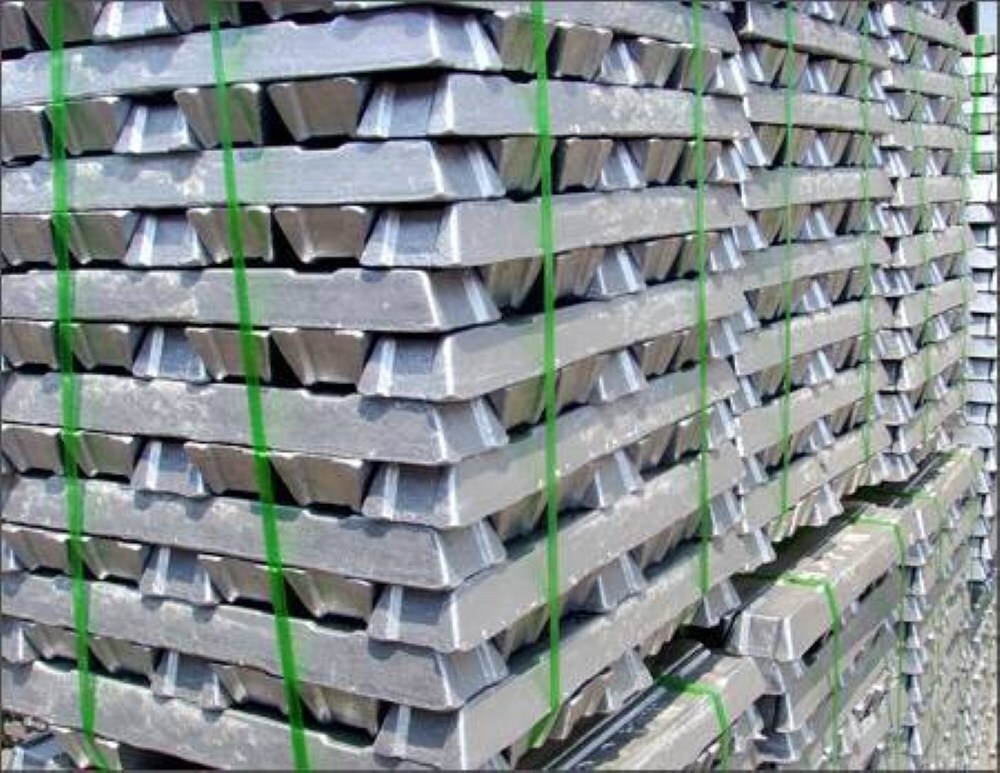
China's weak macro signals and the fading hope of the US Fed rate cut have resulted in aluminium price drop of 1.35 per cent, settling at USD 266.85.
In addition, supply concerns due to a 9 per cent month-on-month decline in China's October primary aluminium output, standing at 3.8 million tonnes, also contributed to the aluminium price fall. Downside also remained limited due to the Chinese smelters' focus on nudging government-imposed capacity limits, which is directly linked with the rising concerns over the compelled output for the coming months.
Moreover, with the slowest growth in industrial output by about 4.9 per cent, with the retail sales rising at 2.9 per cent, also posed pressure on demand, pulling down the aluminium price. While new home prices dropped by 0.5 per cent, new bank loans slumped sharply, indicating weak credit demand and the continuous stress upon the ongoing property market.
Tightened supply outlook also comes from Iceland's smelter outages, Century Aluminium curtailments, and Alcoa's refinery shutdown in Australia. Concurrently, in the rising premiums, the tightness of the physical market was also reflected, where the premiums of the European aluminium climbed to USD 328, nearly double the levels seen in June.
Nevertheless, the fund inflows into the London Metal Exchange (LME) aluminium have significantly risen, backed by the expectations of a tighter supply. A mixed outlook is seen by the banks, with Goldman Sachs revising its long-term forecast downward. Concurrently, ANZ widened its target outlook for the short-term, aiming for USD 2,900 per tonne whilst observing improved global manufacturing demand.
Aluminium is deemed to be under the long liquidation, where the open interest is USD 2,403, down by 4.94 per cent. The support is seen at USD 265.5 with expected further decline to USD 264. Resistance is recorded at USD 269.6 alongside a breakout, which may lift the price to USD 272.2.
https://www.alcircle.com/news/aluminium-fell-as-chinas-primary-output-rose-0-4-in-october-116247
Bloomberg News | November 17, 2025 | 5:59 pm

Rare earth element yttrium oxide has hit an all-time high after surging almost 1,500% this year, highlighting the fallout of trade curbs from China.
Prices surged to $126 a kilogram, up from less than $8 at the end of 2024, according Asian Metal Inc. In April, China imposed export curbs on rare earths, including yttrium.
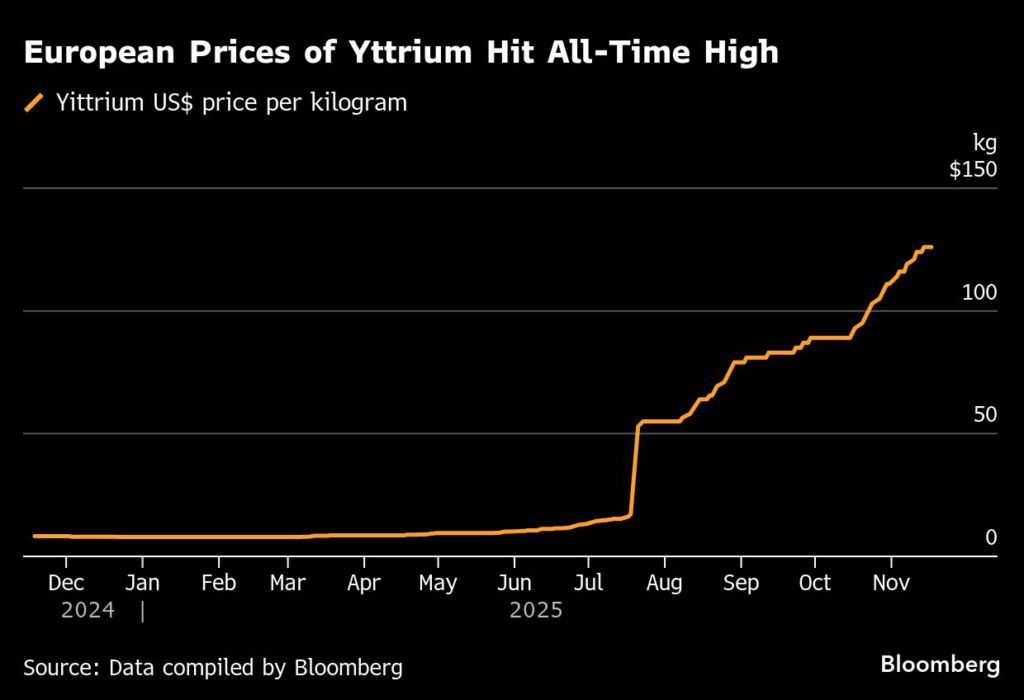
Rare earths — their output, refining, trade, and usage — are at the heart of the drawn-out trade showdown between the world’s two largest economies. At present, China dominates their production, and while Beijing recently agreed to free up sales, the two sides are still negotiating over the details.
Yttrium’s uses include medical technologies, as well as aerospace equipment, ceramics, lasers and superconductors. In the four years to 2023, more than 90% of US imports came from China, according to the US Geological Survey.
In the US, while Pentagon-backed MP Materials Corp. mines yttrium at its Mountain Pass project, the company is stockpiling the material while it plans a downstream expansion.
Elsewhere, Australia’s Lynas Rare Earths Ltd., which produces an array of rare earths, is expanding capacity to produce yttrium from its Mount Weld mine and processing plant in Malaysia.
https://www.mining.com/web/yttrium-price-surges-to-record-as-rally-approaches-1500/
Molybdenum market update on November 20, 2025
The domestic molybdenum market has been generally weak overall. Amid the interplay of bullish and bearish factors, traders’ sentiment varies, primarily reflected in relatively chaotic supplier quotations and a cautious consumption attitude among buyers—despite their willingness to purchase on dips.
In the molybdenum concentrate market, mining enterprises significantly raised quotations in the preceding days. This triggered heightened price aversion among downstream users, leading to fewer inquiries and reduced demand, with product prices surging briefly before retreating.
In the ferromolybdenum market, the overall trend remains under pressure. Influenced by the decline in molybdenum concentrate prices and strong price suppression from steel mills, intermediate smelters have lowered their quotations. Notably, however, steel mills have shown increased inquiry activity under these conditions.
In the molybdenum chemical and related products market, a strong wait-and-see atmosphere prevails. With end-users essentially maintaining only rigid demand and suppliers exhibiting low willingness to ship, the recent sharp ups and downs in raw material prices have not caused obvious disturbance to the prices of molybdenum chemical products and their derivatives.
News update: According to data from the National Bureau of Statistics, of the 623 industrial products tracked for enterprises above designated size in October, output increased year-on-year for 313 products. Key figures include:
Steel: 118.64 million tonnes, decreased by 0.9% year-on-year
Cement: 147.75 million tonnes, decreased by 15.8%
Ten non-ferrous metals: 6.95 million tonnes, increased by 2.9%
Ethylene: 3.14 million tonnes, increased by 11.7%
Automobiles: 3.279 million units, increased by 11.2%, of which new energy vehicles reached 1.710 million units, increased by 19.3%
Electricity generation: 800.2 billion kWh, increased by 7.9%
Crude oil processed: 63.43 million tonnes, increased by 6.4%
The EU plans to limit aluminium scrap exports by 2026 to support domestic industries and bolster recycling efforts.
By Declan Conway
Key takeaways:
The European Commission is preparing to restrict exports of aluminium scrap in an effort to stem the increasing outflow of what is deemed a critical secondary raw material from the bloc.
Trade Commissioner Maroš Šefčovič confirmed the move at a sector event on Tuesday November 18 in Brussels, saying the Commission has started preparatory work on a new measure aimed at tackling “scrap leakage.”
The plan is expected to be finalized and adopted in spring 2026.
“This is a strong and timely statement of intent from the Commission,” director general of Brussels-based industry body European Aluminium, Paul Voss, said.
“Europe’s future will to a large extent depend on its ability to secure access to the raw materials that our economy and our society require. It is therefore hugely encouraging to see the EU acting so decisively to save our scrap,” Voss added.
How much aluminium scrap does the EU currently export?
EU aluminium scrap exports reached a record 1.26 million tonnes in 2024, roughly 50% higher than five years earlier, according to European Aluminium. Much of this material is flowing to Asia, but market distortions created by US tariffs have also played a key role.
About 40% — around 5 million tonnes per year — of the EU’s consumption of aluminium metal comes from recycling, according to European Aluminium.
The US currently imposes a 50% tariff on primary aluminium while exempting scrap, making scrap more attractive to American buyers. This has increased US demand for imported scrap while reducing its own exports, pushing Asian buyers to focus even more heavily on European supply.
European aluminium producers say the surge in exports is now leaving domestic recycling facilities short of feedstock, with an estimated 15% of EU recycling furnace capacity currently offline. The industry has invested heavily in new recycling infrastructure but still lacks about 2 million tonnes of scrap per year to run plants at full capacity.
Many aluminium producers are calling for a 30% export duty on aluminium scrap to try and keep more material within Europe.
Šefčovič said that any final policy will be “balanced” and take into account the interests of producers, recyclers, downstream manufacturers and exporters.
He highlighted the environmental viewpoint: recycled aluminium needs 95% less energy than producing primary metal, making steady access to scrap essential for the EU’s decarbonization goals, as well as for low-carbon industries such as automotive and renewable energy equipment.
Why do aluminium scrap suppliers oppose the EU’s restrictions?
But scrap suppliers strongly oppose export restrictions, arguing that high export volumes reflect weak domestic demand and insufficient EU capacity for processing mixed-grade scrap, particularly from end-of-life vehicles. Suppliers said that limits on exports may undermine the scrap industry, threaten jobs and disrupt Europe’s circular-economy objectives.
Scrap dealers, too, are resisting any curbs because overseas buyers typically pay higher prices than domestic customers.
The European Recycling Industries’ Confederation (EuRIC) argues that the solution is not tariffs, but stronger demand for recycled aluminium inside Europe.
Market participants estimate that a 25-30% export tariff would add €50-150 per tonne to the cost of scrap leaving the EU, assuming that purchasers pass that cost on to their bids. For domestic scrap, market participants say €20-40 per tonne may be added to prices, particularly for high-grade material, while marginal grades may see discounts or be stockpiled.
But those effects would depend, market sources have said, on freight rates, EU smelters’ willingness to pay more and stable energy costs.
The Commission has already put a metal scrap surveillance system in place, rolled out in mid-2025, to track export flows more closely. The data is expected to feed into a formal assessment next year, after which policymakers will decide between options such as export duties, export licensing, or mandatory recycled-content targets.
https://www.fastmarkets.com/insights/eu-moves-to-restrict-aluminium-scrap-exports/

The company's offers for the week of November 17-23 increased by $15/t
American steel company Nucor continues its cycle of hot-rolled coil (HRC) price increases, gradually raising weekly spot prices for consumers (CSP) for the fourth week in a row. For the week of November 17-23, CSP is $910 per short ton, which is $15 higher than the previous week. This is the most significant increase in the last month, as previous weekly adjustments were only $5-10/t.
Spot order lead times remain stable at 3-5 weeks, indicating controlled production capacity utilization and balanced demand in the domestic market. The spot weekly price for Nucor’s West Coast subsidiary, California Steel Industries (CSI), also rose by $10/t to $960/t.
The current price growth demonstrates an acceleration in the price trend and may indicate manufacturers’ desire to maintain positive momentum before the end of the year. The market is responding to a combination of factors, including seasonal supply constraints, stable demand from end users, and manufacturers’ desire to maintain margins amid fluctuating costs.
According to the latest Kallanish estimate as of November 12, domestic prices for US HRC traded in the range of $830-865/t. Thus, the published Nucor level significantly exceeds the average market quotes, forming an additional price benchmark for other producers and traders. Further developments are expected to depend on the pace of demand recovery and the market’s reaction to a series of increases that have been ongoing for over a month.
In late September and October, the global hot-rolled coil market showed opposite trends in the main regions.
European prices rose under the influence of the expected strengthening of trade protection. The US saw prolonged stability amid weak demand, while China again lowered its prices due to excess inventories and uncertainty about the recovery of the industry.
https://gmk.center/en/news/nucor-raises-prices-for-hot-rolled-steel-for-the-fourth-week-in-a-row/

The government is also looking into speeding up the replacement of its own protective measures
The UK is developing countermeasures against the EU’s proposed steel tariff increases in case it fails to reach an agreement to mitigate their impact. This was reported by Bloomberg, citing sources.
The issue is being considered after the country’s steel industry warned that European plans could lead to the biggest crisis in its history.
The British government is also considering how to speed up the replacement of its own protective measures on steel, which expire in June, and to tighten import quotas, insiders said.
Although the sources did not specify what steps are being considered in response to Europe, any escalation would mark a shift in the UK’s position, which has so far sought to avoid trade wars. It would also raise new questions about efforts to rebuild ties with Brussels.
EC spokesman Olof Gill said the EU would work with all partners in the free trade agreement, explain the new measures and their implications, and discuss further action. At the same time, the bloc will continue to emphasize the need for a collective decision to address the problem of global overcapacity.
According to the British government’s estimates, the new European measures will have a significant impact on the country’s steel industry. The EU market is critically important for the industry, with more than three-quarters of UK rolled steel exports shipped to the bloc last year.
However, according to one source familiar with the sector’s views, Britain is also a large enough buyer of European steel for the threat of retaliatory tariffs to cause concern in Brussels.
It should be recalled that in October this year, the European Commission presented a significant strengthening of protective measures on steel imports. The EC’s statement caused concern among the bloc’s trading partners. In particular, even before the proposal was announced, British steelmakers indicated that the reduction in the bloc’s quotas threatened them more than US tariffs.
https://gmk.center/en/news/the-uk-is-considering-options-for-responding-to-european-steel-tariffs/

Social partners call on EU institutions to introduce new trade measures by April 2026
The European Steel Association (EUROFER) and the industriAll Europe trade union federation warn that the EU cannot wait until June 2026 to introduce new protective measures on steel imports. This is stated in a EUROFER press release.
As noted, the urgency of the issue has not changed since October, as the steel sector is under pressure, imports are at record levels, and jobs are at risk.
EUROFER and industriAll Europe stressed that the European Commission’s proposal must be adopted as a matter of priority and implemented well before the current protective measures expire.
The social partners call on the EU institutions to act immediately by introducing new trade measures by April 2026 and backing them up with a real industrial strategy.
They noted that there is currently no improvement in the economic outlook for the sector. Demand for steel remains low, with no significant recovery in sight, EU capacity restructuring is marked by closures, while global competitors are building new plants and global overcapacity continues to grow. In addition, the bloc continues to be flooded with cheap imports, which already account for 27% of the market share, twice as much as in 2012. The utilization rate of European capacity remains unsustainable.
In addition, there is massive stockpiling, undermining the future impact of new trade measures even before they take effect.
“If the new trade measures do not come into force by April 1, 2026, next year will be another lost year for European steel producers. That is why their swift adoption by the European Parliament and the EU Council is of paramount importance. We cannot afford amendments that delay adoption,” EUROFER said in a statement.
In October this year, the European Commission presented a proposal to protect the EU steel industry from the unfair impact of global overcapacity. This involves limiting duty-free imports to 18.3 million tons per year, which is a 47% reduction compared to the 2024 steel quotas, and doubling the duty rate on products outside the quota to 50%.
Stainless Steel Cost Support Weakens, Futures Decline, Spot Prices Remain Weak [SMM Stainless Steel Daily Report]
SMM November 20 - SS futures continued to hit bottom. Today, SS futures extended their previous weakness, breaking below the recent low of nearly 5 points and once falling to 12,255 yuan/mt. In the spot market, SS futures kept declining intraday, further dampening purchase sentiment. Traders had to cut prices for sales, but transactions remained sluggish. Today, a major stainless steel mill announced procurement prices for high-grade NPI and high-carbon ferrochrome. The high-grade NPI price was set at 880 yuan/mtu, and the December procurement price for ferrochrome was set at 8,395 yuan/mt (50% metal content). Its ability to drive down raw material prices was limited, and stainless steel costs remained high, suggesting that the decline in planned production might be modest. This week, social inventory saw destocking, down 1.28% WoW to 940,000 mt.
The most-traded SS futures contract was in the doldrums. At 10:30 a.m., the SS2601 contract was quoted at 12,330 yuan/mt, down 5 yuan/mt from the previous trading day. In Wuxi, spot premiums/discounts for 304/2B were in the range of 390-640 yuan/mt. In the spot market, the average price of cold-rolled 201/2B coil in Wuxi was 8,025 yuan/mt; the average price of cold-rolled edged 304/2B coil was 12,675 yuan/mt in Wuxi and 12,700 yuan/mt in Foshan; the price of cold-rolled 316L/2B coil was 24,300 yuan/mt in Wuxi and 24,300 yuan/mt in Foshan; the price of hot-rolled 316L/NO.1 coil was 23,700 yuan/mt in Wuxi; the price of cold-rolled 430/2B coil was 7,600 yuan/mt in both Wuxi and Foshan.
Stainless steel entered the off-season at year-end, with downstream demand significantly weak and market sentiment pessimistic. In the short term, the impact of macro policy support has gradually faded recently. With SHFE nickel and ferrous metals prices falling and weak fundamentals, SS futures continued to grind at the bottom, now at relatively low levels for the year, but bearish sentiment persists. Supply side, although several stainless steel mills announced production cut plans at year-end, the actual implementation in November was limited, and cuts were mainly concentrated in the 200-series stainless steel, which had seen significant production increases earlier. Production of 300-series and 400-series stainless steel remained largely stable, resulting in a limited overall supply decline. Cost side, losses at stainless steel mills persisted, and their acceptance of high-priced raw materials was low. Coupled with pessimistic market expectations, mills drove down prices for raw material purchases. Prices of high-carbon ferrochrome, high-grade NPI, and stainless steel scrap all trended weaker, lowering the cost center of stainless steel and weakening price support. Current stainless steel prices are already at low levels, facing resistance to further declines. However, given weak demand, limited production cuts by stainless steel mills, and weakened cost support, stainless steel prices are expected to remain weak.
Iron ore futures prices climbed on Monday to their highest in two weeks, driven by firm near-term demand and revived hopes of stimulus from top consumer China after a raft of weak data.
The most-traded January iron ore contract on China's Dalian Commodity Exchange (DCE) TIO1! closed daytime trade 1.81% higher at 788.5 yuan ($110.97) a metric ton, its highest level since November 3.
The benchmark December iron ore (SZZFZ5) on the Singapore Exchange rose 1.57% to $104.2 a ton, as of 0715 GMT, its highest level since November 4.
China will strengthen fiscal policy over the next five years, the country's finance minister said on Saturday in an interview with Xinhua News Agency.
The world's second-largest economy is on track to achieve its annual growth target of around 5%, but a batch of weak data has underlined challenges ahead and reignited hopes of stimulus from a politburo meeting in December.
Meanwhile, an unexpected improvement in demand has supported a rebound in ore prices, analysts at broker Zhenxin Futures said in a note.
The average daily hot metal output, a gauge of iron ore demand, snapped six straight weeks of decline and climbed 1.1% on-week to a three-week high of 2.37 million tons, as of November 13, data from consultancy Mysteel showed.
Price gains were still limited though, due to pressure from swelling portside inventories and rising shipments.
Other steelmaking ingredients coking coal NYMEX:ACT1! and coke (DCJcv1) climbed 0.75% and 1.76%, respectively.
Steel benchmarks on the Shanghai Futures Exchange gained ground. Rebar RBF1! rose 1.64%, hot-rolled coil EHR1! jumped 1.57%, wire rod (SWRcv1) ticked 0.52% higher and stainless steel HRC1! nudged up 0.04%.
($1 = 7.1054 Chinese yuan)
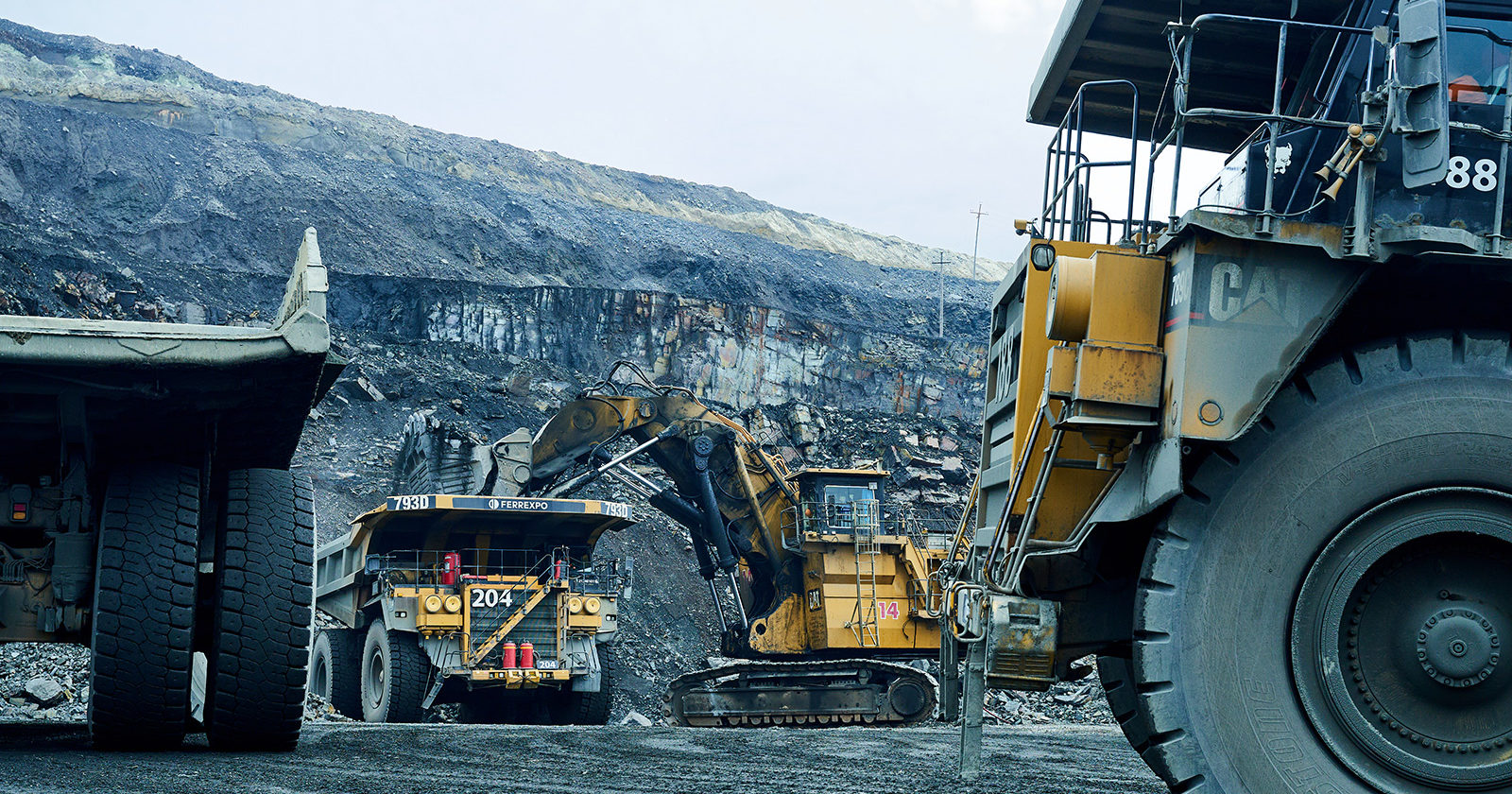
Ferrexpo, the London-listed iron ore producer with operations in Ukraine, is moving forward with its “Green Mine” initiative, a multi-phase program designed to electrify and automate the company’s mining operations in Ukraine.
As the company reported in its recent Responsible Business Report, this step could significantly cut both carbon emissions and long-term production costs.
The project, formalised in 2023, represents one of the company’s most ambitious environmental investment project to date. Together with MEC Mining, a leading global technical research and consulting firm, Ferrexpo has conducted comprehensive study based on a ten-year plan to identify opportunities for the electrification of its mining operations.
The first phase of the study included identification of the most effective electrification options for Ferrexpo’s open-pit mines. A joint project working group visited various mines and OEM manufacturers across North America, Asia, and Australia, and participated in industry events to evaluate available options. The research concluded that large 300-tonne electric-diesel trucks – with trolley-assist where feasible – are the most suitable choice, given the topography and scale of Ferrexpo’s mining operations. Another considered solution involves replacing the current fleet of diesel and diesel-electric locomotives with battery-electric models.
In the second phase, Ferrexpo has launched conceptual design work for a pilot trolley-assist project at its Yeristovo Mine. Engineering partners ABB and MEC Mining are helping define the project scope, including the design of power infrastructure, fleet composition, maintenance requirements, and the location of charging stations. The pilot study has already identified optimal mine pit ramps and haulage routes for the installation.
The analysis conducted has offered a comprehensive view of the project’s CAPEX and potential operating cost savings. While further steps, such as site preparations and equipment procurement, are needed before any investment decisions can be finalized, Ferrexpo has already begun preliminary discussions on possible funding options that consider both the ending and continuation of the war.
As previously reported by GMK Center, Ferrexpo had prewar plans to invest $3.3 bln to reach net zero emissions. The company has already identified key projects that will drive the majority of its carbon emissions reductions, including transitioning to biofuel in the pelletizing process, phasing out fossil fuels from energy mix, electrifying mining vehicles and equipment, introducing HVO-fueled barges.
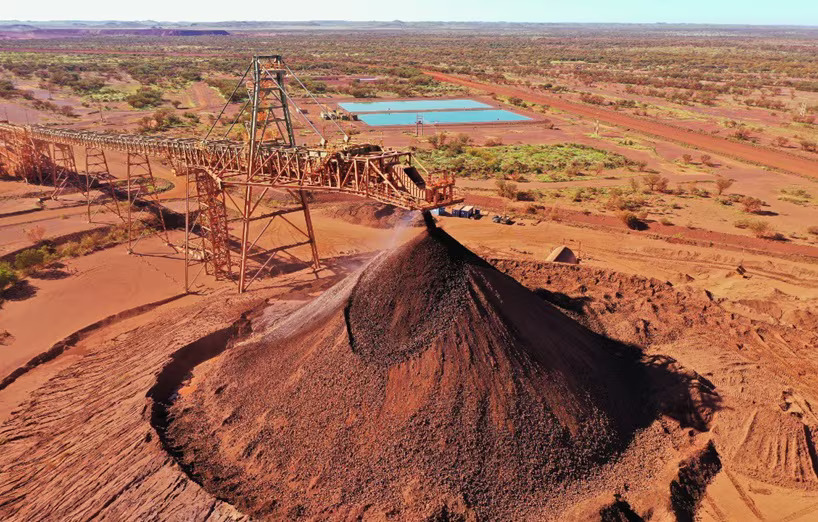
The Jimblebar iron ore mine is a part of an 85:15 joint venture between BHP and Mitsui and ITOCHU. Credit: BHP
Protracted negotiations between China’s state iron ore buyer and miner BHP have tightened availability of some iron ore, seven sources said, underpinning prices despite weakening demand for the key steelmaking ingredient.
China Mineral Resources Group (CMRG), set up in 2022 to centralize iron ore purchasing and win better terms from miners, asked Chinese steel mills and traders in September to stop buying BHP’s Jimblebar Blend Fines while negotiating annual contract terms with the Australian miner for 2026 supply.
Trade of Jimblebar fines is still frozen in China, leaving mills that previously used it switching to a substitute, Pilbara Blend Fines (PBF), rival Rio Tinto’s flagship product, resulting in a rapid drawdown in PBF inventory, the sources said.
A BHP spokesperson told Reuters “negotiations are ongoing”, declining to elaborate. CMRG did not immediately respond to a Reuters request for comment.
Rio Tinto had no immediate comment.
Portside inventories of PBF began falling in mid- to late September and were down by around 40% to 6.5 million tons on November 18, the lowest since August, according to two of the sources with knowledge of the matter.
By contrast, portside stocks of Jimblebar fines, which account for around a quarter of BHP’s production, continued to pile up, surging by 156% over the same period, one of the sources said.
All sources requested anonymity due to the sensitivity of the matter.
Thinning margins have propelled Chinese steel mills to favor medium-grade cargoes such as PBF, heating up competition and accelerating the drawdown in port inventories, sources said.
Profitability among Chinese steel mills has been falling since mid-August, with only around 39% of mills operating at a profit by November 13, versus 55% in the same period a month before and 58% at the same time in 2024, data from consultancy Mysteel showed.
Iron ore futures prices hit a more than two-week high on Wednesday even as crude steel output in the world’s largest producer of the metal slid to the lowest level since December 2023 as bad weather led some northern mills to cut production.
The tightened availability of PBF at Chinese ports contributed to surprising resilience in iron ore prices, said the two trade sources and the other two analysts, with one of them adding that the situation created a “man-made bull market”.
Ore prices have climbed 3% from a month before and 8.4% from the beginning of the year to close at 791.5 yuan ($111.23) per metric ton on Wednesday.

Metso says it has contributed the core process design and technology for Fortescue Ltd’s Christmas Creek Green Metal Project in the Pilbara, Western Australia, where installation of Metso equipment commenced in September 2025.
The project will demonstrate the production of high-purity green metal using renewable energy for hydrogen-based reduction and smelting technologies for further downstream steel processing. The project incorporates Metso’s Circored™ fluidised bed direct reduction process and electric DRI Smelting Furnace to support low-emission steelmaking.
“Green metal presents a huge opportunity for Australia’s iron ore industry and Fortescue is determined to lead the way,” says Dino Otranto, Fortescue’s Chief Executive Officer of Metals and Operations. “Through the Christmas Creek Green Metal Project, we’re combining cutting-edge technologies, including Metso’s Circored™ process and DRI Smelting Furnace, with Fortescue’s proven track record in project delivery, to pioneer low-emission pathways for steelmaking.”
This initial project will have an annual output of over 1,500 metric tons, with studies underway to support development of a commercial-scale facility.
“This project, which implements the Circored™ and DRI smelting solutions, underscores our commitment to advancing sustainable and efficient industrial processes,” says Attaul Ahmad, Vice President, Ferrous and Heat Transfer at Metso. “The Circored™ process uses solely green hydrogen instead of fossil reductants. This flexible fine ore-based fluid bed process, which does not need pelletisation, produces highly metalised direct reduced iron (DRI) that can directly be used as feed material in electric smelting furnaces for carbon-free steelmaking, using low-grade iron feed.”
“The low-emission electric smelting (ESF)-based steelmaking route, which substitutes traditional blast furnaces in the production of hot metal, is well-suited for Australia’s abundant, low-to-medium-grade Pilbara iron ores. The ambitious target for the Metso DRI Smelting furnace technology is to unlock utilization of these massive iron ore reserves for green iron making, when such iron ores previously have been not suitable for the DRI steelmaking route due to higher gangue content. We are excited to see the Metso DRI Smelting Furnace taking shape at the Christmas Creek site where foundations have been laid and the first equipment was installed in September,” says Jyrki Makkonen, Vice President, Smelting at Metso.