
US interest rates have been raised for the first time in more than three years to 3.75%-4% from 3.5%-3.75% by the Federal Reserve. Fed Chair Kevin Warsh warned they could be increased further later this year in a bid to slow rising prices.
The increase comes despite fierce opposition from President Donald Trump, who had called for rates to be cut.
The president on Wednesday accused top Federal Reserve policymakers of acting against him for political reasons.
Karachaganak, one of Kazakhstan’s three largest oil and gas fields, entered planned maintenance on September 7, a shutdown expected to reduce the country’s oil and gas condensate output by 400,000–450,000 metric tons before work ends on October 1.
The interruption comes in a year when the government has already lowered its national production forecast following repeated disruptions to the Caspian Pipeline Consortium (CPC), the main export route for Kazakhstan’s oil.
In August, Energy Minister Yerlan Akkenzhenov said Kazakhstan had lowered its 2026 oil production target from 98 million to 96 million metric tons. He put production losses from attacks on CPC infrastructure in January, June, and July at about 3.5 million metric tons.
CPC loadings rebounded by 22% in August after July’s disruptions, reaching around 1.6 million barrels per day (bpd). CPC exports are expected to fall to about 1.5 million bpd in September, partly because of the Karachaganak maintenance.
More than 80% of Kazakhstan’s oil exports move through CPC. The July shutdown at the Black Sea terminal showed how quickly an export disruption can force production cuts at fields far inland. On July 22, Kazakhstan’s oil and gas condensate output fell by about 21%, while output at Tengiz dropped 56%, from roughly 925,000 to 406,000 bpd.
Karachaganak also depends on Russian processing infrastructure. Raw gas from the field is sent to Russia’s Orenburg gas processing plant. In June, Karachaganak reduced production after an incident at the plant sharply curtailed its intake of gas from the field.
Karachaganak Petroleum Operating B.V. (KPO), the field’s operator, is expanding its gas reinjection capacity. The process returns some of the produced gas to the reservoir, helping to maintain pressure and sustain oil and gas condensate output.
A fifth gas reinjection compressor began operating in 2024. In June 2026, KPO announced that the KEP-1B project, which includes a sixth compressor, had begun reinjecting gas ahead of schedule. The Energy Ministry has said the two compressors would help maintain Karachaganak’s liquid hydrocarbon production at around 11–12 million metric tons a year.
Following the expansion of Tengiz, Kazakhstan had expected national oil production to approach 100 million metric tons a year. Its production capacity has increased, but the events of 2026 have exposed the limits of the infrastructure used to move that oil to market.
In May, Akkenzhenov said there was no full-scale alternative to CPC. Some oil can be rerouted across the Caspian into the Baku-Tbilisi-Ceyhan pipeline or east to China, but these routes cannot absorb CPC-scale volumes. CPC can carry up to 72.5 million metric tons a year from Kazakhstan.
Whether or not the maintenance reduction was already incorporated into the revised forecast, Kazakhstan has little room for further disruption to the export and processing infrastructure on which its production depends.
https://timesca.com/karachaganak-maintenance-cut-kazakhstans-oil-output-450000-tons/

Crude oil inventories in the United States saw a decrease of 600,000 barrels during the week ending September 11, according to new data from the U.S. Energy Information Administration (EIA) released on Wednesday. The decrease brings commercial stockpiles to 423.4 million barrels, according to government data, which are now 1% above with the five-year average for this time of year.
The EIA’s data release follows API’s figures that were released a day earlier, which reported that crude oil inventories had gained 7.14 million barrels in the period.
Crude futures were trading down at 10:26 a.m. in New York. Brent futures were trading at $107.36 per barrel—down $1.39 (-1.28%) on the day but up roughly $1.30 per barrel from this same time last week. WTI was also trading down on the day, by $2.03 per barrel (-1.92%) on Thursday morning at $103.80, up about $3 per barrel since this time last week.
For total motor gasoline, the EIA reported that inventories increased by 800,000 barrels, after gaining 1.3 million barrels in the week prior. The most recent figures showed that average daily gasoline production rose to 9.6 million barrels. For middle distillates, inventories increased by 1.6 million barrels with production decreasing to an average of 5.2 million barrels daily. Distillate inventories are now 13% below the five-year average.
Total products supplied—a proxy for U.S. oil demand—averaged 20.5 million barrels per day over the last four weeks, down 0.6% compared to the same period last year. Gasoline demand averaged 8.8 million barrels per day over the last four weeks, with the distillate four-week average supplied at 3.6 million barrels—down 3.3% year over year.
By Julianne Geiger for Oilprice.com
https://oilprice.com/Energy/Crude-Oil/US-Oil-Inventories-Edge-Lower-as-Fuel-Demand-Softens.html

Alcoa has approved US$1.5 million of funding to Equus Energy for a gas project in West Australia.
The funding will unlock the second phase f the project, which will be used for project partnering activities.
Approval and funding will enable Equus to focus on securing the operating, LNG offtake, infrastructure and financing partners required to advance the project towards front-end engineering design and a final investment decision.
Stage Two approval follows Alcoa;s acceptance of the Stage One pre-FEED deliverables.
It comes after Equus executed a binding 10-year gas sales agreement with Alcoa in August.
The company said engagement with several strategic operating partners had commenced, with those parties reviewing the outcomes of the pre-FEED work.
Eqqus Managing Director Will Barker said: "Alcoa’s approval of Stage Two is another important milestone for Equus, reinforcing the project’s position as a strategically important source of future gas supply for Western Australia.
"North West Shelf gas production is in steep decline, with existing LNG facilities facing significant spare capacity in the early 2030s at the same time as Western Australia requires new sources of domestic gas.
“We are ideally positioned to help fill that supply gap.
“We have a large, independently certified gas resource, a capital-efficient development pathway that leverages existing infrastructure, and a binding 10-year domestic gas agreement with Alcoa.”
The gas sales agreement with Alcoa will see Equus make about 50 terajoules of gas per day available for the aluminium producer.
That equates to about 182 petajoules of gas over the 10-year contract term.
Stage One pre-FEED identified a development concept based on a phased tie-back using a leased floating production, storage and offloading vessel, third-party pipeline infrastructure and existing LNG and domestic gas processing facilities.
The company said the work confirmed a technically robust and capital-efficient development pathway for the project.
https://aluminiumtoday.com/news/alcoa-approved-australian-gas-project-funding
.jpg)
Treasury Secretary Scott Bessent predicted earlier in September that the Strait of Hormuz would be irrelevant to the oil trade in two years because overland pipelines will bypass the Persian Gulf chokepoint. In light of the Houthi attacks on Saudi Arabia’s East-West pipeline, Bessent’s prediction is already aging like spoiled milk.
Bessent first made the prediction in August and then doubled down at the G20 finance ministers’ meeting in Asheville, North Carolina.
“In two years, the Strait of Hormuz will be … a worthless piece of water,” he told Fox Business’ Larry Kudlow on Sept. 1, adding oil “will be going on pipelines across land” and therefore diminishing Iran’s leverage.
But the Houthis’ recent drone strikes on the Saudi pipeline show that a world in which the Strait of Hormuz is completely “worthless” might be much harder to realize.
The Houthis executed a 36-hour offensive, capturing around 2,000 square kilometers of territory, including key coastal areas along the Bab el-Mandeb Strait, a vital maritime corridor for trade and oil.
They also appeared to have attacked the Yanbu Aramco Sinopec Refining Company, a massive refinery on Saudi Arabia’s Red Sea coast, Tuesday. Oil loadings also appear to have ground to a halt at Saudis’ Red Sea export terminal in Yanbu, according to a Reuters report.
The East-West pipeline is a crucial asset for the state-owned Saudi Aramco. It is the primary land-based alternative to the restricted Strait of Hormuz, carrying crude oil across the Arabian Peninsula from ports in the Gulf Sea to the Red Sea port city of Yanbu.
Kathleen Tyson, a global markets expert and former Federal Reserve banker, mocked Bessent’s prediction Tuesday.
“Just another great call from US Treasury Secretary Bessent. He said in 2 years Gulf pipelines would make Strait of Hormuz ‘irrelevant,’” she wrote on X. “[The Houthis] hit Yanbu oil loading port infrastructure and 6 more pumping stations on Saudi’s East-West Pipeline. Hormuz will never be ‘irrelevant.’”
The Houthi strikes and drone attacks immediately led to an increase in global oil prices Monday, with Brent crude jumping over 3 percent to top $107-$108 per barrel after the supply chain disruption. Throughout September, the price of oil has surged 20 percent, according to CNBC.

WindEurope has elected Ørsted CEO Rasmus Errboe as its new Chair and Enel Green Power CEO Salvatore Bernabei as Vice-Chair, with both beginning an 18-month tenure as Europe’s wind industry heads towards a record year for new installations.
Europe is on track to install 24 GW of new wind capacity in 2026, according to WindEurope. The figure would be enough to power around 20 million European households.
However, the association warned that the sector’s current momentum cannot be taken for granted, pointing to persistent structural challenges including cumbersome permitting procedures, slow grid expansion and insufficient electrification, which it says are undermining investment in new wind projects.
WindEurope also highlighted poor auction design and uncertainty surrounding the EU’s 2040 renewables target as risks to Europe’s energy and security objectives.
Errboe said wind energy is key to addressing Europe’s challenges and called for faster electrification, expanded grids and conditions that support investment across the region.
“Europe has built a world-leading wind industry as part of the solution to these challenges. We now need to turn ambition into action,” he said.
Bernabei will also take over as Chair of the WindEurope Management Committee, while Alfredo Parres of Hitachi Energy will become Vice-Chair of the committee.
“I am honoured by the trust placed in me by WindEurope’s members, in a pivotal moment for Europe’s competitiveness, industrial resilience and energy security,” Bernabei said.
WindEurope said wind already provides 480,000 jobs across Europe and remains one of the few clean technologies in which the region has a presence across the entire value chain, from research and manufacturing to onshore and offshore wind.
The association also said a renewables-based power system could save Europe up to €1.6 trillion by 2050, including the additional costs associated with grids, storage and system integration.
The new leadership succeeds outgoing Chair Henrik Andersen, CEO of Vestas, whom WindEurope thanked for his leadership and commitment during his tenure.
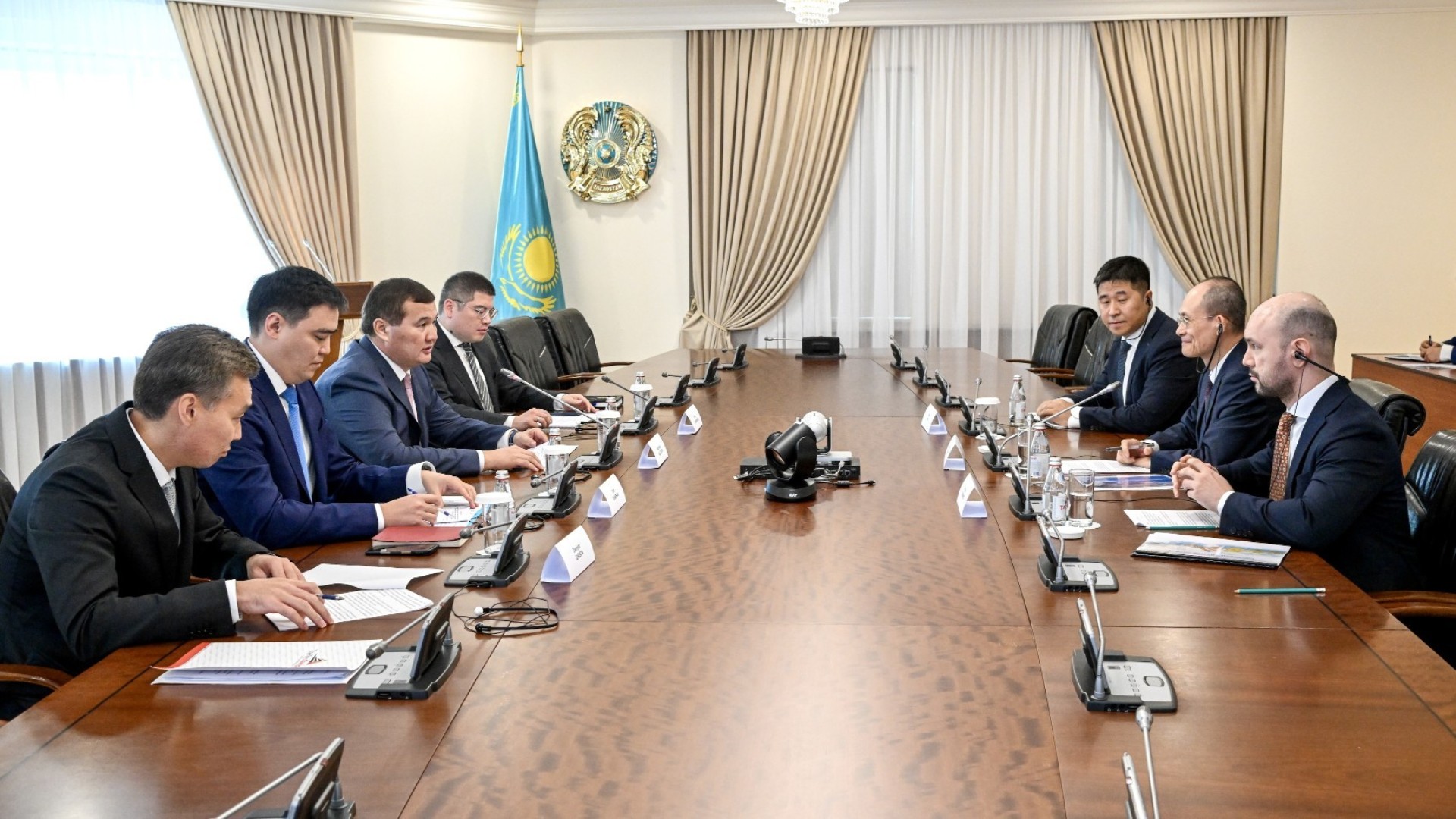
BAKU, Azerbaijan, September 16. China's Zijin Mining Group has expressed interest in developing Kazakhstan's Shalkiya lead-zinc deposit in the Kyzylorda region, Kazakhstan's government said.
First Deputy Prime Minister Nurlybek Naliyev met with representatives of Zijin Mining Group to discuss investment cooperation in Kazakhstan's mining and metallurgical sector, including the development and processing of solid minerals.
"The parties discussed prospects for investment cooperation in the mining and metallurgical sector, including projects for the development and processing of solid mineral resources," the government said.
Zijin Mining Group expressed interest in Shalkiya and readiness to explore the possibility of participating in the project, the statement said. The sides also discussed deep processing of mineral resources, the introduction of modern technologies, job creation, and environmental and industrial safety.
The parties agreed to continue cooperation on promising areas, according to the government.
Zijin Mining Group is among the world's largest mining companies. In 2025, it produced more than 1 million tons of copper, ranking fourth globally, while its gold production reached 90 tons.
In Kazakhstan, Zijin Mining Group operates at the Raigorodok deposit in the Akmola region. The company is investing more than $600 million in the construction of a new gold processing plant. The project will add processing capacity of 10 million tons of ore per year, increasing the total capacity of the mining and processing complex to 16 million tons.
According to ShalkiyaZINC company, the Shalkiya deposit was discovered in 1959 and is one of the world's largest zinc and lead deposits. It contains more than 30% of Kazakhstan's total zinc reserves and ranks among the world's largest deposits by zinc reserves. The deposit is located 17 kilometers northeast of Zhanakorgan in Kazakhstan's Kyzylorda region.

Surge Copper Corp. [SURG-TSXV] said the Initial Project Description (IPD) for its 100%-owned Berg Copper project has been accepted by the British Columbia Environmental Assessment Office and the Assessment Agency of Canada.
Berg is a large-scale copper-molybdenum-silver-gold development project located in central British Columbia.
The company submitted the IPD on September 9, 2026. It’s acceptance formally commences the Early Engagement phase of the provincial environmental assessment process and the planning phase of the impact assessment process.
Surge CEO Leif Nilsson said Berg is entering environmental assessment from a strong technical foundation following completion of the preliminary feasibility study (PFS) earlier this year, while substantial environmental baseline, engineering and engagement programs continue. “We look forward to working collaboratively with First Nations, local communities, regulators, and other participants as the project progresses through this next stage,’’ he said.
In a June 15, 2026, press release, the company said the PFS envisages a 28-year mine life with total production of 8.6 billion pounds of copper equivalent (CuEq), including 4.9 billion pounds (2.2 million tonnes) of copper, 602 million pounds of molybdenum, and 89 million ounces of silver.
Life of mine average annual production is estimated at 308 million pounds (140,000 tonnes) of copper equivalent, including 176 million pounds (80,000 tonnes) of copper, 21 million pounds of molybdenum and 3.0 million ounces of silver.
The initial capital cost is pegged at $4.7 billion, with sustaining capital of $1.7 billion. A selected development case is based on a 120,000-tonne-per-day concentrator and a new 230 Kv transmission line connecting the project to the BC Hydro grid and downhill overland conveyor to transport ore to the process plant.
The PFS outlines a simple, stand-along development case, based on a single-phase build conventional open pit mining, and processing with no reliance on phased expansion or third-party major infrastructure.
The study is based on maiden proven and probable mineral reserves of 1.2 billion tonnes, grading 0.22% copper, 0.026% molybdenum, 4.1 g/t silver, and 0.02 g/t gold, containing 5.8 billion pounds of copper, 687 million pounds of molybdenum, 160,000 ounces of silver and 0.8 million ounces of gold.
On Wednesday, Surge Copper shares rose 1.75% or $0.01 to 58 cents. The shares trade in a 52-week range of 92 cents and 17 cents.
The Berg deposit is a calc-alkaline copper-molybdenum porphyry system. The PFS confirms Berg as a significant emerging critical minerals development project, located 28 kilometres northwest of the company’s 100%-owned Ootsa gold-molybdenum-silver project.
https://resourceworld.com/surge-copper-enters-environmental-assessment-process-in-b-c/
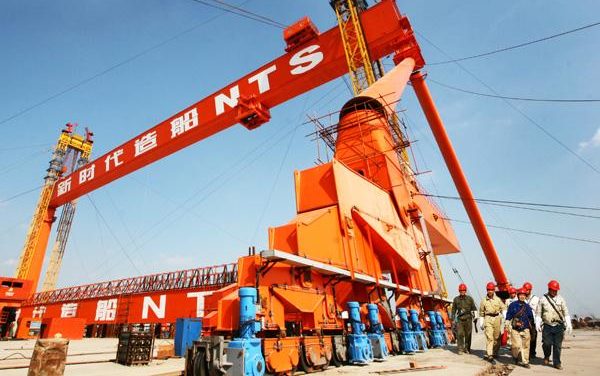
South Korea’s Wooyang Shipping has ordered four newcastlemax bulk carriers at China’s New Times Shipbuilding for long-term employment with Brazilian mining giant Vale.
The 210,000 dwt ships are scheduled for delivery in 2029 and 2030 and will be capable of running on ethanol, methanol and conventional fuel oil. Industry estimates put the price at around $108m per vessel, taking the four-ship investment to roughly $432m.
The quartet is backed by 25-year transportation contracts with Vale worth a combined $1.65bn, with extension options that could add up to another five years.
Wooyang already has exposure to Vale’s long-haul iron ore business. The Busan-based owner added two 325,000 dwt ore carriers in 2025 through a South Korean state-backed financing programme, with the vessels deployed on long-term contracts with the Brazilian miner.
The latest order shifts Wooyang from acquiring secondhand Vale-backed tonnage to purpose-built ships designed around long-duration employment.
Vale’s wider fleet renewal programme has been gathering pace across several Asian owners. HMM recently secured a KRW4.7trn ($3.4bn) 25-year transportation deal covering eight 210,000 dwt ships, while Polaris Shipping has also lined up new tonnage against Vale business.
Together with the Wooyang quartet, the HMM and Polaris orders account for 16 newcastlemaxes now tied to Vale’s latest fleet programme.
New Times has also been picking up other Korean-backed 210,000 dwt business. Splash reported last week that H-Line Shipping had ordered two LNG dual-fuel newcastlemaxes at the yard for long-term employment with Posco, with the ships priced at about $94m apiece and due in 2030.
https://splash247.com/wooyang-lines-up-430m-vale-backed-newcastlemax-quartet/
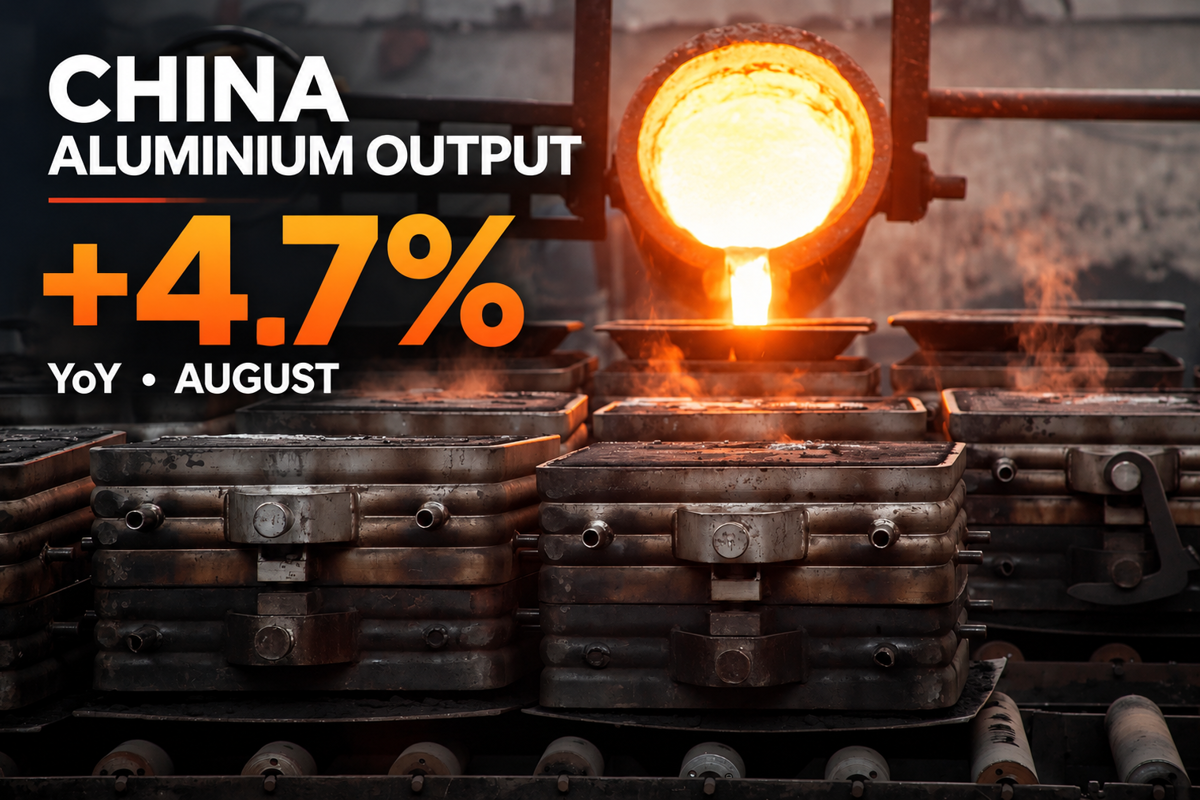
China's aluminium production reached a record high in August as strong margins encouraged smelters to maximise output, bringing the world's largest aluminium producer closer to its longstanding national capacity ceiling.
Primary aluminium output rose 4.7 per cent year on year to 3.98 million tonnes in August, according to data from the National Bureau of Statistics. Production was also higher than the just-under 3.9 million tonnes recorded in July and was close to the previous monthly record of 3.979 million tonnes set in June.
China's aluminium output for the first eight months of 2026 reached 31.12 million tonnes, up 3.9 per cent from the same period a year earlier.
At the current pace, annual production would reach around 46.7 million tonnes, above China's 45 million-tonne capacity ceiling. The country has maintained strict controls on aluminium smelting capacity since 2017.
Strong margins support higher aluminium output
Aluminium prices have risen following supply disruptions in the Middle East linked to the war. Benchmark three-month aluminium on the London Metal Exchange has gained nearly 8 per cent so far this year, including an 1.82 per cent increase in August.
China produced 45.02 million tonnes of primary aluminium in 2025, representing a 2.4 per cent increase from the previous year.
The continued growth in 2026 therefore puts annual output on course to exceed last year's production level, although the pace of production also raises questions around the country's closely controlled smelting capacity.
Non-ferrous metal production also rises
Production of 10 non-ferrous metals, including copper, aluminium, lead, zinc and nickel, increased 1.6 per cent year on year to 7.1 million tonnes.
For January-August, combined output of the 10 metals reached 55.58 million tonnes, up 2.9 per cent from the same period last year.
https://www.alcircle.com/news/china-aluminium-output-rises-4-7-yoy-to-record-high-in-august-121190

Washington wants to bring the copper supply chain home, but the result could be record refined imports in one direction and US-mined concentrate heading back out to sea in the other.
US copper policy is beginning to produce exactly the kind of trade-flow distortion that creates new opportunities for shipping.
Broker Banchero Costa reported that the US imported a record 225,094 tonnes of refined copper and copper alloys in July, the highest monthly total in data going back to 1990. The figure was up 78% month-on-month and 8% year-on-year as traders rushed material into the country ahead of possible tariffs.
This front-loading has created one of the more unusual commodity stories of the year: America is trying to reduce its dependence on imported copper while simultaneously sucking in unprecedented volumes of refined metal.
The longer-term picture could become even stranger. Broker Affinity noted in a recent report that the US already imports around half of its copper requirements, while refined imports have increased around sixteen-fold since 2015 as domestic production has declined.
Demand, meanwhile, is heading in the opposite direction. Copper consumption is expected to rise sharply as investment in artificial intelligence infrastructure, power grids, electrification and defence accelerates, putting growing pressure on an already stretched domestic supply chain.
The US possesses substantial copper resources, but Affinity highlighted a critical bottleneck: smelting. Only two primary copper smelters remain operational in the country, meaning new domestic mine production does not necessarily translate into domestically refined metal.
Rio Tinto’s giant Resolution Copper project in Arizona could eventually supply more than a quarter of US copper demand, according to Affinity. Yet weak domestic smelting economics mean some of its concentrate could ultimately have to be exported for processing overseas.
Treatment and refining charges have already turned negative as smelters compete for scarce concentrate globally, making investment in US processing capacity particularly challenging.
Affinity said Rio has raised a number of possible policy responses, including support for domestic treatment charges, tariffs on cathode imports and even restrictions on concentrate exports.
A system that encourages large refined copper imports while allowing domestically mined concentrate to leave the US would create additional two-way seaborne flows rather than the shortened supply chain Washington is trying to engineer. It would also add another layer to a copper market already being reshaped by scarcity.
https://splash247.com/americas-copper-paradox-sets-up-new-seaborne-trade-flows/
Job Description
Anglo American is recruiting a Mining Engineer for Kumba Iron Ore in Kathu, South Africa. This is a permanent position within the Mining area and is classified at Associate level.
The Mining Engineer will provide mine-planning and design expertise, including developing and governing Mine Activity Designs and deployment strategies to support safe, sustainable and efficient mining operations.
Job Details

Minimum Requirements
Applicants must have:
Technical Knowledge
Candidates should have knowledge and understanding of:
Key Responsibilities
The successful candidate will:
